Showing posts with label KnittingVsCrochet. Show all posts

March 24, 2012

Knitting vs Crochet, Part 2: Does Crochet Really Take More Yarn? (Part 2)

Better late than never.  Click here for Part 1.

Changes
Since I overestimated by ability to keep the swatch size the same, I'm normalizing the height and width measurements by using square inches instead.  So, I'll get the amount of yarn used per square inch.  Easier that way anyway.

Also, since I'm not going by pure measurement, I didn't take pictures of all the swatches.  I did take this one to prove I did them though:


My gauges didn't come out the same either, though not very far off.  Again, since I'm using gauge to calculate the stitch width and height to get me the dimension of the stitch in square inches (I know, it's weird, but it lets me do the amount comparison) in order to get amount used per stitch, the gauge isn't a problem.  I was hoping for a more direct comparison, but oh well. 

I did do the garter stitch and double crochet swatches (which is why it took me so long).

Also, to state, I'm doing everything in inches.  Not standard, but that's what I did because I'm a stupid American who just realized her tape measure has centimeters on it.  Measurements are to 1/16 of an inch.

Results
My raw results are in this chart (sorry for the size...no real way to post this without it running off the page.  However, for integrity, I want to put my raw data here):


Stitch Used Tool Diameter Width (in) Height (in) Swatch Size (sq in) Stitch Gauge (/in) Row Gauge (/in) Stitch Width (in) Stitch Height (in) Stitch Size (sq in) # of Stitches in Sq. In. Length of Yarn Used (in) Amount of Yarn Used per Sq. In. (in) Yarn Used per Stitch (in)
DC 4.25mm 3.7500 2.2500 8.4375 4.5 3.0 0.2222 0.3333 0.0741 13.5000 312.3125 37.0148 2.7418
Garter 4.25mm 4.3750 2.0000 8.7500 5.0 10.0 0.2000 0.1000 0.0200 50.0000 341.6875 39.0500 0.7810
SC 4.25mm 3.7500 2.1875 8.2031 4.5 6.0 0.2222 0.1667 0.0370 27.0000 355.5625 43.3448 1.6054
St St 4.25mm 3.8125 2.3750 9.0547 5.5 7.5 0.1818 0.1333 0.0242 41.2500 297.2500 32.8283 0.7958
DC 5mm 3.8125 2.1250 8.1016 4.0 2.5 0.2500 0.4000 0.1000 10.0000 264.3750 32.6326 3.2633
Garter 5mm 4.2500 2.0000 8.5000 4.5 10.0 0.2222 0.1000 0.0222 45.0000 316.5000 37.2353 0.8275
SC 5mm 3.6875 2.1250 7.8359 4.0 5.0 0.2500 0.2000 0.0500 20.0000 306.0625 39.0588 1.9529
St St 5mm 3.7500 2.3750 8.9063 5.0 6.5 0.2000 0.1538 0.0308 32.5000 250.6250 28.1404 0.8659

To give my formulas:
  • Square Inches = W * H
  • Amount of yarn used per sq. in = [yarn used in whole swatch (in)]/[square inches of area used]
  • Stitch height/width = 1/[row gauge (for height)] or [1/stitch gauge (for width)].  This is because my gauges are all per 1 inch (if you, say, used 4 in for your gauge, it would be 4/[gauge measurement]...or, more explicitly: [gauge measurement]/[# in. for swatch] = 1 st / [x in] -> x = [# in. for swatch]/[gauge measurement])
  • Amount of yarn used per stitch = [amount of yarn used per square inch] / [the number of stitches in a square inch] (which is 1/[size of a stitch in square inches]).
Since that chart is large and pretty unreadable, I created these comparison table, one for amount of yarn used per sq. in. and one for amount used in a stitch.  They are both sorted min to max amount used:

Amount of Yarn Used per Sq. In. (in) Tool Diameter
Stitch Used 4.25mm 5mm
Stockinette Stitch 32.8283 28.1404
Double Crochet 37.0148 32.6326
Garter 39.0500 37.2353
Single Crochet 43.3448 39.0588


Yarn Used per Stitch (in) Tool Diameter
Stitch Used 4.25mm 5mm
Garter 0.7810 0.8275
Stockinette Stitch 0.7958 0.8659
Single Crochet 1.6054 1.9529
Double Crochet 2.7418 3.2633

There's a couple of things here I noticed right away.  The least apparent thing may be easier to see in this graph:


Can't see it?  I've added lines between the 4.25mm data points for on stitch and the 5mm for the next stitch:

Hm.  There's a relationship here. If you order the stitches from least to most yarn used, it shows that you can go to the next stitch, and the only thing you need to do is increase the needle/hook diameter to the next up size and you'll use around the same amount of yarn. And the stitch order staggers between knitting and crochet.  This itself is a nail in the coffin for the whole '3 times more yarn' myth.  I wonder if this trend holds out if you added more diameter sizes.  I really don't want to make up more swatches to find out, though.

On the other hand, to maybe, possibly, give some credence to those who say crochet takes up more yarn, look at the table for per stitch.  Yes, it turns out that both knitting stitches I looked at use less yarn per stitch than both crochet stitches. But then look at this table:


Stitch Size Tool Diameter
Stitch Used 4.25mm 5mm
Garter 0.0200 0.0222
Stockinette Stitch 0.0242 0.0308
Single Crochet 0.0370 0.0500
Double Crochet 0.0741 0.1000

Using the same order of stitches as the second table above, I created one with the stitches size in square inches.  So, yes, the knitting stitches take less yarn.  They also cover less area, which is what I figured. But this still doesn't settle why, when you look at square inches and not stitches, the order changes.  My guess is that the ratio of the area gained in the square inch to the amount of yarn used is not the same for each stitch, and that it would work out to be that the stitch that used the least yarn while covering the most area would be the one to use the least amount of yarn in a square inch.  I don't feel like doing that comparison.  It's not that important to this myth.

Anyway, to get back on track, we get to the final conclusion as seen in the first table (Yarn Used per Square Inch).  So, how much yarn does each craft take against the other?  It depends on the stitch you're using.  Using the same tool size:

Percentage of Yarn Used


Stitch Used Garter Stockinette Single Crochet Double Crochet
Garter 0.0000% 0.0016% -0.0011% 0.0005%
Stockinette Stitch -0.0019% 0.0000% -0.0032% -0.0013%
Single Crochet 0.0010% 0.0024% 0.0000% 0.0015%
Double Crochet -0.0005% 0.0011% -0.0017% 0.0000%

Table is read down, then across (so pick a stitch on the left hand side, then find the stitch to compare it to at the top, then find where they meet to find the percentage more of yarn the first took against the other.  If it's negative, it took less.

None of these are anywhere close to 3 times the amount. 

There's one more thing I do want to explore here, though.  Those saying that 'crochet takes more yarn' could claim is that, in reality, if a knitter and a crocheter were doing similar projects, they would pick completely different tool sizes.  And, most likely, the knitter would use a bigger tool than the crocheter (my guess based on my experience...if you can prove me wrong, let me know).  This is what I was trying to test with the 'same gauge' thing.  The problem is that the gauges aren't all that compatible between knitting and crocheting.  Should have known that. 

However, the data I do have shows that this argument doesn't work either.  Look at the first table again.  If, say, a knitter wanted to crochet something that would normally be in garter stitch and still use a similar amount of yarn, just change it to double crochet.  Going from garter to double crochet results in less yarn being used, and if you go down a tool size or two (which you would), it'll use close to the same amount of yarn.  Once again, it comes down to what you're doing in that craft.  The knitter could use less yarn and therefore get more out of the same yardage, but the crocheter could do so too.

Conclusion
Therefore...myth  BUSTED.  Crocheters aren't using up all your yarn.  Actually, you may be using more yarn than a crocheter, since it all depends on stitch and tool size chosen.  And even if the crocheter is using more yarn, they're NOT using anywhere close to 3 times as much.  So stop repeating this myth.

February 26, 2012

Knitting vs Crochet, Part 2: Does Crochet Really Use More Yarn? (Part 1)

I hear this one a lot.  I hear it in my craft group, I read it on Ravelry forms, I read jokes about it in knitting books.  In the craft world, it seems that it's common knowledge that crochet uses more yarn. 

As a crocheter, knitter, and a wannabe skeptic, my first reaction to all of this is 'is it really true, or is it one of those non-facts that take a life of their own?  Does crochet really take more yarn, or is it a perception issue?'  The good news is that this can be tested, and that is exactly what I'm going to do.

Background
The first concrete quote of this fact that comes to my mind can be found in the knitting humor book Yarn Harlot: The Secret Life of a Knitter by Stephanie Pearl-McPhee, where she claims:
"Another bad thing about crochet: It uses three times more yarn than knitting to cover the same area" (Kindle location 1372; chapter 3, part 6, para. 7).
This is also the only quote I've read so far that gives an amount.  Three times as much?  I find that a little hard to believe, even if crochet does take up more yarn than knitting.  This also give me a starting point for my method, but I'll get to that later.

(On a unrelated note, she's the only knitting blogger I check every day.  There's a reason for that.  Go read some of her stuff.  Really.)

Unfortunately, you'll have to go with my word on the rest, as they were spoken or I can't find them again.  I did Google 'crochet yarn amount' and found a quote on a blog that repeated a variation of the above.  So it's out there.  From somewhere.

What I'm Testing and Method
So, what this comes down to is, does crochet really use more yarn?  But this is a trickier question than it looks. By what do you mean 'crochet takes up more yarn'?  The quote above mentions that crochet should take three times as more yarn as knitting for the same area, that is, the same swatch size. However, that doesn't take into account gauge.  I could knit a 6st to the inch swatch and crochet one with 3st to the inch, and I wouldn't be surprised when the knitting swatch takes up more yarn.  I could knit the same 3st to the inch, and maybe use less yarn.  I also may create a fabric with a shit-ton of holes as well.

Another way of looking at it is by calculating how much yarn each stitch in both knitting and crocheting take up.  I suspect this is where the 'fact' comes from: my guess is that a single crochet, done on the same diameter tool and in the same yarn as a knit/purl stitch would take up more yarn.  The crochet stitch would also be bigger. But that's the thing, you use more yarn but get a bigger stitch, and therefore you cover more area.  So the first way is the better way to look at it, if we standardize for gauge, though I'll do this for kicks to see if my guess has merit.

A third is by stitch type.  Single crochet will take less yarn than double crochet stitch wise, but more row wise.  Stockinette...well, I don't know enough about knitting to guesstimate it.  And once you start looking at shells or cables or any of the multitudes of ways one can manipulate yarn it gets crazy real quick.  I think this highlights the simplicity of this question (after all, if I compared my crazy cable blanket to that baby blanket I did...it'd be meaningless, actually.  One is tons of cables, the other is shells and clusters.  How do you compare the usage of yarn between them, even standardizing for size and yarn weight?).  How much yarn you're using depends on what stitches you're doing, and a simpler stitch is going to take less yarn than a crazy clusterfuck of stitchery, but it may or may not gain you more row height.  However, for the purpose of this test I will assume that what is meant is the simplest level, and by that I mean the stockinette stitch for knit and the single crochet for crochet.  Now, I know there are simpler (garter and slip stitch, to be exact), but stockinette and single crochet are the 'standard' gauge measurement stitches. They also make my life easier.

So, my official plan is:
  • Pick a yarn for the test.
  • Find out what hook size and what needle size will get me the SAME stitches per inch for both the knit and the crochet.
  • I'll crochet with one and knit with the other using the needle sizes determined above, making a swatch about 4" by 2", including COs and BOs and Chain 1's.  I'll knit in stockinette stitch and crochet in single crochet.  I'll mark where the tails end, so that when I pull it out, I won't count the tails in the amount of yarn (as they are too variable).
  • I'll then, taking the same yarn, swap out the hook size for the needle size and vise versa and knit and crochet two more swatches.  This will give me two knit swatches and two crochet swatches that can be compared two different ways: one set will be the same gauge.  The other two will be the two crafts at the same diameter size but not at the same gauge (for stitch sizes).
  • I'll record the gauge size, and the size of one stitch for each swatch.  I'll then rip it back out and measure how much yarn I used (not including any tails of yarn).
Process
I'm using this yarn:

Which is a part skein of some Bernet Softee Baby.  I picked it because it's a standard, acrylic yarn that's a light color (for visibility).

My rough swatches have determined that a size G hook (4.25mm) and a size 8 needle (5mm) get roughly about 5 stitches per inch with this yarn.  The same diameter needle size to the G hook is a US 6.  The same diameter hook size to the US 8 is an H hook:


As you can see, I'm using all the same manufacturer as well.

Results
...Are to come, since I got to make all the swatches!  I have one done:


But I got to do the rest.  I do need to make sure that it's just barely 4", as my first swatch is a little on the short side.  Hence the ruler to prove that all the swatches are as close to the same size.

UPDATE: The results are in!  Click here to go to Part 2.

November 6, 2011

Knitting vs Crochet, Part 1: Tools and Notions

For my first serious post, I'm going to start a series comparing knitting (which is what I mostly do now) and crochet (my first love).  This one will be about the tools requires for the trade, and how they compare to each other.  And I have pictures, since earlier today I decided to re-organize all my craft tools.

But first, I would like to announce that I finished this:


I'll go over my final thoughts on it in a write-and-dash post later.  Now, to the comparison.

Knitting

To knit one simple project, you really only need two needles of the correct size. You may also need something like a stitch marker or a counter, but I won't count those because you need them for both crafts.  That's it.  Simple, right?

Nope.  Not in the slightest.  One of the more shocking things to me about knitting was how may damn needles you need to do all the projects you want to do.  Want to knit a sweater?  Depending on the sweater, you may be able to get away with a set of straight needles in the correct diameter (if knit flat or a cardigan), or you may need one or a couple of circular needles in the correct size and length, and a set of DPNs or longer circular needle to do the sleeves.  If it has ribbing, you usually need another set of needles a size down.  If you do hats, you usually use 16" circulars and DPNs, or a longer circular to Magic Loop the whole hat, presuming the hat's worked in the round.  For socks, you'll need tiny DPNs or long circulars that you most likely wouldn't be using for other projects. I could go on and on.  The thing is, if you knit anything and everything like me (well, not everything. I haven't gotten to socks yet since I don't usually like to wear them, but I will eventually) in any and all yarn weights (I've knitted everything from super bulky to light fingering), you end up needing a lot of different needles.  If you're a person who prefers straight needles (not me), you're going to need a whole set of straights, a whole set of DPNs, and some circulars for those random projects that need to be knitted in large rounds.  If you like circulars like me, you maybe could get away with less needles, assuming you prefer magic loop as well and don't buy a whole set of DPNs before you realize that.

That's the other thing, though.  If you're new, you're usually directed to the straight, cheapo needles and set to go (unless, of course, you learned from someone who preferred differently and/or knew better).  That's what I started on, having learned out of a book bought at a big-box craft store.  Then, if you expand your horizons beyond scarfs, you'll mostly likely find your way to DPNs and circulars when needed.  If you don't hate circulars and/or don't absolutely love and can't deal without straight needles or just prefer circulars, you would be smart to sit back, realize that in order to do all the things you want to do, you'd need to buy not only a different size needle, but 3-5 different lengths for the circulars, so it'd make sense to invest in a interchangeable set now, before you buy all those needles.  You'd be really smart to realize that you prefer magic loop before you buy all the DPNs, but hey, it's the price I pay for learning without another knitter around.

Anyway, here's all my current tools:


I was lucky and realized I preferred circulars and things knitted in the round early, so I went and bought the interchangeable set from KnitPicks, which definitely has saved me money and kept my needle count down.  I chose this one because I prefer metal needles and decent prices, and the other two metal sets in existence didn't fit both criteria (Boye's is cheap, both in price and quality, and the other one (I'm blanking on the brand) was more expensive for less sizes).  I've had a couple of issues with the cables popping out of the metal screw top, and needles becoming unscrewed despite being tightened, but nothing major or constant (and KnitPicks did replace a cable for free when it broke on me the first time I used it.  They're pretty good about that).  And I have to say, I love the sharp points.  My right index finger will beg to differ, but that's all right.

Oh, and I still need more needles if I ever get around to that sock, since the smallest interchangeable head is a US 4, and I don't own a solid US 0, 1, or 2 in a length above 24".

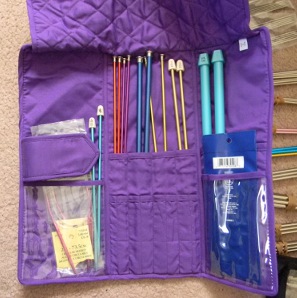
Also note the notions in the right hand corner.  Needle caps, cable needles, stitch holders...all notions unique to knitting.  Even with the interchangeable set keeping some of the cost down, I'd have to say that all those tools in that picture are worth around $200 US dollars (still need to actually tally it).  Not counting the purple holder at the bottom, which has the straights I bought before I went circular and interchangeable:


That's probably another $40-$50 there.


Crochet

So, what do you need to crochet anything and everything?  This:


That's it.  Well, it's not all the crochet hook sizes you can get (I don't own my own Q or M hook, nor all the 'steel' ones), and I managed to lose my G hook when it fell out of a hole in the plastic bag I had a project it (which, ironically, was a knitting project.  I was carrying it around to pick up stitches if I needed to), but that's all the crochet hooks I've ever used.  I've crocheted everything from super bulky yarn to crochet thread as well, so it's a good range.  That whole thing cost me around $40.  If I got the rest of the set, it would cost me around $60-$70.  Of course, this presumes you get the same hooks I did, which the cheap Boye ones (which are fine since I prefer metal hooks, and all a crochet hook has to do is hook the yarn through a loop.  I also prefer the hook shape on the Boye's; there's another cheap brand that does a different style hook, and I don't like it.  That's probably what the green, extra K hook I have on the left is.  I never use that hook).  If you go to a mid-upper-level style of hook, it may cost more more like $100 (though I just looked, and you can even get a Clover soft set for $40, though you may  need a couple extra sizes).

Conclusion

So, in terms of tools, crochet is pretty good.  Only need a small set of crochet hooks, maybe some shared notions like a stitch marker and/or row counter, and you're set.  Knitting requires way more tools and notions, and that costs money.  Also, due to the way you use knitting needles, quality becomes a lot more important, also upping the cost.  In conclusion, if you're really broke and don't already knit or crochet, learn how to crochet.  Or stick to one area of knitting, so you don't need as many tools.  Or find a knitting friend that will loan you stuff.  They all work. If you're not broke, then just be prepared to spend a lot building up your tool stash if you're learning to knit.  Or ignore how much money you're spending on your hobby.  Either way works.