It's about time I do something for the crocheters out there. I tend to focus on knitting for these posts since I learned how to knit in recent memory, and so I come across stuff in my own travels. On the other hand, my mother taught me to crochet when I was 8. It's been awhile.
However, I was in a conversation recently about how one hold the yarn and hook in crochet. Turns out there's a lot of unofficial variation out there, despite there being only two ways to both hold the hook and to actually crochet. So I figured that it would be a good idea to not only cover the official ways, but some of the variations out there as well...because, you never know, you may like it better!
Styles vs Variations vs Whatever You Call It
First note that no matter what you may think, the term crochet style is not used the same way the term knitting style is. A knitting style, as you may know, is how you hold and manipulate the yarn to produce all your stitches. Crochet style...let's just say that it isn't used much to mean how you hold the yarn and hook to produce your stitches. That would make too much sense. Unfortunately, searching fails here. After searching for the term crochet style on Google, it seems like no one uses it the same way at all. The first entry is a Pinterest board and the second is a eHow article where the author calls both Tunisian crochet (a different yarn craft with different tools and stitches) and free-form crochet (I could see the usage, but I would call this an approach) 'styles'. It doesn't get any better, on the first two pages at least.
The truth is, there isn't a comprehensible term because the 'styles', in the knitting sense, aren't modular packages like the knitting styles are. You have the hand you use to hold the hook, and then you have variations that you can pick and choose to use with the hand-style. I'll call the first the base, since all variations follow from this.
Speaking of such, variations are things like how to hold the hook and wrap the yarn around your fingers. Basically, variations of the standard way of crocheting. Some of these may be 'official', but some may just be the way you learned or fell into. I'll cover some of the more popular ones here.
The official ways of holding the crochet hook are sometimes called positions or holds as well. As you can see, terminology really isn't consistent in crochet.
The Base of Crochet Methods
All variations to crocheting start with what hand you use to hold the hook. The hand you use to hold the hook is usually determined by your dominate hand, so unless you're ambidextrous or have problems with one of your hands, you'll probably have learned or will learn one base and stay with it.
For example, say you're like me and you're severely right-handed, you'll start with the hook in your right hand, and use your left hand to hold tension in the yarn. This is usually called Right-Handed Crochet.
On the other hand (ha), you are dominantly left-handed, you'll do the opposite: you hold the hook in your left hand and the yarn in your right. This is called Left-Hand Crochet.
If you don't favor one hand over the other much, you could pick and choose. However, I would recommend that you go with the right hand. Why? Because almost all crochet patterns presume right-handed crochet. One of the consequences with choosing a base is that it determines which way you create the loops and therefore build the fabric. With right-hand crochet, you work from right to left, and vice versa. This has little overall consequence for the final product, or even what variations you use, but unless you're good with spacial thinking, left-handers may find it difficult to picture what's going on in the instructions or provided pictures. That, and depending on the pattern writer, they may use 'left' instead of 'next stitch' or other similar phrases that assume right-handedness. Left-handed crocheters have to watch out for that and mirror as needed.
Though, as you may suspect, handedness isn't the end all be all of it. Since the non-dominate hand does the work of holding the yarn (and usually the work-in-progress), you may find that you prefer the hold the hook in your non-dominate hand instead so that the yarn is in your dominate hand. Hand-ness is more important in crochet than, say, knitting, but it isn't everything many make it out to be.
Since to give real instructions means introducing some of the variations (after all you still need the way to hold the hook and yarn to start), I don't have any guides here, but here's a good list of myths associated with left-handed crochet.
Variations
So how do you hold the hook and hold tension in the yarn? Well, that's a lot more complicated. There's a lot of variation, and it has little to do with the base or necessary technique usage and a lot about preference or what your teacher (both meatspace and not) used. The only effect on the final product these variations have is personal to the crocheter...that is, you may find that one method produces neater stitches for you vs another. Therefore, I won't make any broad recommendations as to which one to try first or learn. You need to play around to find your best fit.
Holding the Hook
There are two official methods of holding a crochet hook: the knife method and the pencil method. These are no way the only two variations in holding the hook, but they are what you'll run into if you learn from most sources, and I'd say the many of the variations are variations of these two methods.
The knife method, also called the overhand or over-the-hook method, is called that because you hold the crochet hook like you would a knife. See the second set of pictures on this site and this site (also the third set there), and the first set on this site for slightly different variations on this method. The key is that the shaft is under the palm of the hand with your thumb and some forefinger or set of forefingers on the grip. While some sources will say to use your index finger and thumb, you can also use your middle finger and thumb, or all of them. The other fingers aren't technically involved in the classic style of this method, but you may find yourself wrapping your pinky, ring finger, or both around the shaft of the hook (for stability and/or to help guide or move the hook). Another connected variation is holding it 'fist like', like many of the commenters in the second link. The hook can be facing you (see the first and third link), towards the floor (see second link), or the opposite of both of those (I guess, though I haven't see it). However, hook position will be more of a consequence on how you hold the hook instead of a direct choice. You may also turn the hook as you're crocheting.
The pencil method, also called the underhand or under-the-hook method, is also named after the common utensil in which the grip is similar. See the first set of pictures in the first two links above, and the second in the third link for examples. The key here is that the shaft is resting on or floating around the area between the thumb and forefinger, and only those two fingers are holding the crochet hook. This method is a little less popular and so there seems to be less examples of variation to it, but it's possible. For example, you can use your middle finger to grip instead of your pointer, and use the pointer to guide the hook (I tried it and found it easier that way than standard pencil grip, actually, but then again I'm weird and use my middle finger and thumb to grip all hooks and needles).
Holding the Yarn
On the other hand, there's no 'official' methods to hold the yarn, and the variations are endless. However, there are right ways and wrong ways to do it. This is because the way you hold the yarn has a direct effect on how tightly or loosely your stitches will come out (for the knitters out there, this doesn't hold as true for knitting due to how the stitches are produced, but that's a different topic). Use the wrong hold, or the wrong one for you, and your stitches may be uneven, too loose, or too tight.
I say the wrong one for you because a right method that works for a million people may not work with your hand, especially since this is the non-dominate one we're most likely talking about. Hands vary in size, shape, or strength, and that will have an effect on which method you prefer. For example, you might have cause two of your fingers to be stiff and prone to locking up because you rammed that hand into a bookcase years ago (ok, maybe that's just me). Things like that all can have an effect. The style you'll like may also change over time and incidents. That's fine. As long as you're getting good results, it doesn't matter.
One common way to hold the yarn is to wrap the yarn first around your pinky, and then over one of the other fingers (index, usually, but the middle can also be used) as a guide. The fourth and fifth pictures down on this site shows this, as well as the first yarn hold method on this page (scroll past the hook holds). Another variation is the second picture in this link. The pinky wrap provides the tension, and the other finger is a guide to hold your yarn so that you can grab it with the hook. This method may give you a tighter tension than others, but it can also impede yarn flow as the yarn has to pull through the twist around the pinky finger.
Another is to pull the yarn between your pinky and ring finger, and then pull the yarn from under your fingers up and over your index (or middle) finger. Grasping the yarn between the last two fingers provides the tension, and again, index or middle is your guide. You can see this variation in the third picture of the first link in the last paragraph. This way provides a looser tension, depending on how hard you grip the yarn with your last two fingers. It may be too loose or you may find that you grip too hard to be conformable with this method.
A third is to hold the yarn with your last two or three fingers (bent towards the palm to hold it), and again, put it up over your index finger. The third example in the third link above, and the second yarn hold method in the second link show this way. This way is even looser in tension, if you need that.
There, are, of course, many other methods out there...way too many to list. The last example on this link (same as the third above) is another, more unique way (the comments are sources for other variations and methods as well). This link is a variation on the second one I listed that involves having the source of the yarn under the palm instead of over (makes more sense when you look at the picture). This one shows the crochet just holding the yarn between the index and middle finger.
If you really have no clue about which one to try, start with one of the three discussed above and modify from there (and if it's unconformable, then try another). Don't get too frustrated at first, though. Learning how to control tension in crochet takes some practice no matter what way you hold the yarn.
Conclusion
All in all, crochet methodology is fluid and you may have to experiment to find the way you like. Have fun with it; after all, it's most likely your hobby. Or will be, I hope.
Showing posts with label learning to crochet. Show all posts
Showing posts with label learning to crochet. Show all posts
March 30, 2013


October 7, 2012
The Dilemma of Classes
If any of you went to VogueKnitting Live New York last year, you probably received an email stating that you could pre-register a couple of weeks ago (turns out, you can only pre-register for the crazy expensive all-inclusive packages, so the rest of us are stuck waiting). Ok, cool, I thought. Now I won't sign up last minute...hm, class list; maybe I should take a class this time...
As I was looking down the list of classes, I noticed a lot of them are of the vein 'learn a this technique' or 'learn more ways to cast-on and off'. Which is all fun and good...except I could find you instructions for ten different ways of casting on in ten minutes just sitting here at my computer. I could even find a couple of videos for some of them if written instructions aren't your thing. What's the point, then, of spending around $50-$60 to learn something I could just Google, or even spend at most $25-$30 for a book that has that has ten times more information that I can refer to indefinitely?
Now, I do get that there are people out there that need or want the physical presence of the instructor and the interactive instruction to learn something in knitting and crocheting, no matter how simple. The point of this post isn't to behoove them, or make fun of the fact that the classes exist. No. My dilemma, as an active self-teacher, is at what point is taking the class worth it? At what point is what is being taught too complicated to detail on a web site, show on a YouTube video, or follow from a book? What wisdom can only be found by paying $60 for a class?
It's not an easy question, though I have some notion of the answer. You see, a couple of months ago I decided to make a mini-vacation out of Rhinebeck, partly as a gift to myself for last July (see, I *can* sign up for these things before the last minute). Since I earned overtime for that month, money wasn't so much of a concern. So, the first thing I did was decide to take a class. Unlike VogueKnitting Live, however, I looked through the class list for Rhinebeck once and immediately found what I wanted to take. I'm going to be learning how to design a sweater.
Of course, I've already technically designed a sweater. Two, if you count this disaster. So why that class? Because I haven't been successful in actually getting a pattern down, and I'm hoping that learning some techniques for designing will help me knock out my half-assed design-on-the-fly methodology that isn't working as well as I'd like. Also, unlike cast on techniques or how to do stranded color-work, learning design and pattern-writing isn't a concrete, step-by-step process. There's no 'do x, then y', so it doesn't lend itself to online tutorials, nor does it benefit designers to over-think themselves and explain it for free. Sure, there's books out there. I own a couple and have more in my (private) Amazon wish list. But what I've done obviously isn't enough.
So, is my self-teaching limit at the point of designing from scratch? No, I don't think so; there's more books I can read, and I could benefit from a good stitch dictionary right now at least. But it is the point where self-teaching becomes experimental and frustrating; where there's no straight how-to and over-researching is paralyzing so I do too little of it, ending up stuck. It makes me realize how little I know of this craft. So, when money isn't an object and I'm treating myself, it makes some sense to take the class. Who knows, it may help, and hopefully it's fun.
But that brings me back to VogueKnitting. Can I justify even taking a class on design when I have to justify spending the money? Can I justify any of them? That's my dilemma, and at this point that depends what I end up using from any class I rationalize myself into taking.
Knowing me, I'll end up signing up for something anyway. It's not like I needed to attend a lecture either, but I've been to one of those already (it was more due to the pricing structure and wanting to get the hell out of my apartment that time). I have into November 27th to decide before it costs more.
As I was looking down the list of classes, I noticed a lot of them are of the vein 'learn a this technique' or 'learn more ways to cast-on and off'. Which is all fun and good...except I could find you instructions for ten different ways of casting on in ten minutes just sitting here at my computer. I could even find a couple of videos for some of them if written instructions aren't your thing. What's the point, then, of spending around $50-$60 to learn something I could just Google, or even spend at most $25-$30 for a book that has that has ten times more information that I can refer to indefinitely?
Now, I do get that there are people out there that need or want the physical presence of the instructor and the interactive instruction to learn something in knitting and crocheting, no matter how simple. The point of this post isn't to behoove them, or make fun of the fact that the classes exist. No. My dilemma, as an active self-teacher, is at what point is taking the class worth it? At what point is what is being taught too complicated to detail on a web site, show on a YouTube video, or follow from a book? What wisdom can only be found by paying $60 for a class?
It's not an easy question, though I have some notion of the answer. You see, a couple of months ago I decided to make a mini-vacation out of Rhinebeck, partly as a gift to myself for last July (see, I *can* sign up for these things before the last minute). Since I earned overtime for that month, money wasn't so much of a concern. So, the first thing I did was decide to take a class. Unlike VogueKnitting Live, however, I looked through the class list for Rhinebeck once and immediately found what I wanted to take. I'm going to be learning how to design a sweater.
Of course, I've already technically designed a sweater. Two, if you count this disaster. So why that class? Because I haven't been successful in actually getting a pattern down, and I'm hoping that learning some techniques for designing will help me knock out my half-assed design-on-the-fly methodology that isn't working as well as I'd like. Also, unlike cast on techniques or how to do stranded color-work, learning design and pattern-writing isn't a concrete, step-by-step process. There's no 'do x, then y', so it doesn't lend itself to online tutorials, nor does it benefit designers to over-think themselves and explain it for free. Sure, there's books out there. I own a couple and have more in my (private) Amazon wish list. But what I've done obviously isn't enough.
So, is my self-teaching limit at the point of designing from scratch? No, I don't think so; there's more books I can read, and I could benefit from a good stitch dictionary right now at least. But it is the point where self-teaching becomes experimental and frustrating; where there's no straight how-to and over-researching is paralyzing so I do too little of it, ending up stuck. It makes me realize how little I know of this craft. So, when money isn't an object and I'm treating myself, it makes some sense to take the class. Who knows, it may help, and hopefully it's fun.
But that brings me back to VogueKnitting. Can I justify even taking a class on design when I have to justify spending the money? Can I justify any of them? That's my dilemma, and at this point that depends what I end up using from any class I rationalize myself into taking.
Knowing me, I'll end up signing up for something anyway. It's not like I needed to attend a lecture either, but I've been to one of those already (it was more due to the pricing structure and wanting to get the hell out of my apartment that time). I have into November 27th to decide before it costs more.
September 8, 2012
Learn to X Instruction Review: The Contents of a Good Instructional Guide
Before I start my commencement of posting reviews of knitting and crochet instructional guides, I first want to establish what I look for in such a guide. After all, it wouldn't be fair to rag on a site I found, or a book used, without stating why I find it so bad.
So, without further ado, I present what a good knitting and/or crochet instructional guide should be. A good guide:
1) Is clearly written and well organized.
Obviously, one person's opinion of 'clearly written' and 'well organized' will be different than someone else's. However, truly horrible organization, out-of-order presentation, and incomprehensible instructions should be pretty obvious as things you don't want your guide to be. A good guide doesn't take the learner forever to find basic information, gives instructions in simple and concise language (and/or pictures when necessary), and is presented in an order that let's the student build on previous knowledge.
2) Will at least name the style they are teaching, if not actually presenting the learner with more than one way of doing something.
I get it, guide writers don't want to confuse people and have a writing deadline. But I say by just telling people 'this is how you cast on, this is how you knit, this is how you crochet', guide writers are actually doing the learners a disservice. First off, maybe the person reading the guide will hate the way you're teaching them, but would be more suited for an alternate method. For example, maybe they're current crocheters learning how to knit, and would be more comfortable knitting Continental style instead of the English style. If you start by reading some of these guides, you won't have a clue what I just meant by that last sentence, and that's bad. Learners like this, when attempting to use a guide that only presents one way, are more likely to get frustrated and give up. They can't learn! they'll say, not realizing that there's more than one way to do it.
The other downside with this format is that while the learners may be fine with the one presented method in the beginning, they then may run into issues when they decide to branch out past the stockinette or garter stitch square. What if you need a different cast-on, or another way to start a crochet circle? Someone who was taught 'this is how you do x' is going to be confused when they run into a problem better served by a different method. Someone who at least was informed, if not shown, a different way will be more likely to look for and use the better way.
All in all, I think it's better for a guide to show at least two methods of doing something. It gives the learner a choice and lets them feel out what is best for them. If the guide doesn't show more than one method, at least it should tell the learner they're learning, say, the knitted cast-on, and that this is only one of many ways of doing it.
3) Will present all the basic techniques needed to knit or crochet almost anything
Yes, us more experienced knitters know the beginner's going to be knitting a scarf, and gauge isn't crucial. This doesn't excuse the guide writer of skipping any mention of gauge, even if it's after teaching the student how to knit a square. A good guide will teach concepts like gauge from the start, as it'll save heartache when the beginner decides to move on.
4) All the information is correct.
This should be a given. No sympathy for incorrect statements.
Also related: If you teach to a pattern or provide beginner's patterns, make sure they don't have any mistakes in them. A intermediate crocheter like me will realize quickly that there's a mistake. The beginner's just going to keep following your instructions blindly and will most likely blame the bad result on their inexperience. Mistakes in patterns is another topic, but just make double sure that a teaching pattern is correct.
I think this is the basis of a good learning guide for beginners. For learning guides for more intermediate skills, I'll say that 1, 2, and 4 are all still relevant, though 2 a little less so (after all, for some of the more advanced techniques there is only one way to do it. Also, at this point, if you're looking up more advanced techniques, you're going to know to search for another method if you don't like the one you found). Intermediate guides tend to focus on one technique, and that's fine. It doesn't excuse unclear explanations, bad websites, not naming the technique (unless you made it up, then say that), and in-factual information. Now, onto the reviews!
PS: I apologize for the previous post that was here; I click the wrong button and accidentally published my draft.
So, without further ado, I present what a good knitting and/or crochet instructional guide should be. A good guide:
1) Is clearly written and well organized.
Obviously, one person's opinion of 'clearly written' and 'well organized' will be different than someone else's. However, truly horrible organization, out-of-order presentation, and incomprehensible instructions should be pretty obvious as things you don't want your guide to be. A good guide doesn't take the learner forever to find basic information, gives instructions in simple and concise language (and/or pictures when necessary), and is presented in an order that let's the student build on previous knowledge.
2) Will at least name the style they are teaching, if not actually presenting the learner with more than one way of doing something.
I get it, guide writers don't want to confuse people and have a writing deadline. But I say by just telling people 'this is how you cast on, this is how you knit, this is how you crochet', guide writers are actually doing the learners a disservice. First off, maybe the person reading the guide will hate the way you're teaching them, but would be more suited for an alternate method. For example, maybe they're current crocheters learning how to knit, and would be more comfortable knitting Continental style instead of the English style. If you start by reading some of these guides, you won't have a clue what I just meant by that last sentence, and that's bad. Learners like this, when attempting to use a guide that only presents one way, are more likely to get frustrated and give up. They can't learn! they'll say, not realizing that there's more than one way to do it.
The other downside with this format is that while the learners may be fine with the one presented method in the beginning, they then may run into issues when they decide to branch out past the stockinette or garter stitch square. What if you need a different cast-on, or another way to start a crochet circle? Someone who was taught 'this is how you do x' is going to be confused when they run into a problem better served by a different method. Someone who at least was informed, if not shown, a different way will be more likely to look for and use the better way.
All in all, I think it's better for a guide to show at least two methods of doing something. It gives the learner a choice and lets them feel out what is best for them. If the guide doesn't show more than one method, at least it should tell the learner they're learning, say, the knitted cast-on, and that this is only one of many ways of doing it.
3) Will present all the basic techniques needed to knit or crochet almost anything
Yes, us more experienced knitters know the beginner's going to be knitting a scarf, and gauge isn't crucial. This doesn't excuse the guide writer of skipping any mention of gauge, even if it's after teaching the student how to knit a square. A good guide will teach concepts like gauge from the start, as it'll save heartache when the beginner decides to move on.
4) All the information is correct.
This should be a given. No sympathy for incorrect statements.
Also related: If you teach to a pattern or provide beginner's patterns, make sure they don't have any mistakes in them. A intermediate crocheter like me will realize quickly that there's a mistake. The beginner's just going to keep following your instructions blindly and will most likely blame the bad result on their inexperience. Mistakes in patterns is another topic, but just make double sure that a teaching pattern is correct.
I think this is the basis of a good learning guide for beginners. For learning guides for more intermediate skills, I'll say that 1, 2, and 4 are all still relevant, though 2 a little less so (after all, for some of the more advanced techniques there is only one way to do it. Also, at this point, if you're looking up more advanced techniques, you're going to know to search for another method if you don't like the one you found). Intermediate guides tend to focus on one technique, and that's fine. It doesn't excuse unclear explanations, bad websites, not naming the technique (unless you made it up, then say that), and in-factual information. Now, onto the reviews!
PS: I apologize for the previous post that was here; I click the wrong button and accidentally published my draft.
January 15, 2012
I Seem to Plan These Things at the Last Minute
So, in true me fashion, I found out last week that Vogue Knitting Live was being held this weekend in Manhattan, and therefore made last minute plans to go. Which I can do, since I now don't just live close to the city, but now live close enough where attending was just a matter of hopping on the subway.
Unfortunately, having just moved (as well as had some other unforeseen cost sinks) meant I couldn't afford to take any classes, not that there was a good selection the last week of registration anyway. I ended up doing the 'I Heart NY' package, since paying for that cost just as much as paying for two day marketplace pass, and got you a lecture on top of it. It ended up working out, as I not only went Saturday to attend the lecture as I had planned to in the beginning, but went Sunday to attend one of the free panels as well. Though, being in the marketplace for two days didn't help my budget much. But let me start from the beginning here.
In General
At first, I wasn't too sure about this event. I walked around the marketplace first, saw projects I liked, but not a lot of yarn caught my eye. Contrasting that to Rhinebeck where I saw tons of yarn I liked, it was a little disheartening at first. I'm thinking that part of the reason was that I was trying to be more cautious with my money and space (in contrast to Rhinebeck, where I didn't have a budget or space constraints), and therefore only glanced at all the nice cashmere and silk yarns that are at these events. The other was that the projects I've been thinking of doing were more warmer weather projects, and a lot of the yarn was cold weather stuff (on top of that, none of my project ideas were solid 'I'm doing X' things, which didn't help). The third is that this seems more geared towards the fashion-forward crowd, whereas I'm picky about what I like and it usually isn't popular (for example, I really didn't see any colors I like that wasn't some brand name yarn I can get elsewhere for the same price if I want it). Also, I was hoping I'd find buttons for my baby sweater, but there were very few button sellers. I don't think it helped that I've been in a weird mood for unrelated reasons.
However, there were some interesting thing there. As I said, I did see a couple of projects on display that I loved as a project, though I wasn't interested in the yarn used. One of the vendors had a nice shrug with a stockinette body and cabled collar, with mid-length sleeves. I fell in love with it the first time I saw it. However, the yarn used was some weird yak/wool blend which wouldn't have worked for when I needed the shrug (I have a event in June that I was thinking of making a shrug for), the color choices didn't thrill me, and the yarn wasn't cheap either. As far as I could tell, the pattern itself wasn't on sale. The other projects I saw was just displays of patterns from magazines, and the last thing I need is a magazine subscription. Something to think about, but nothing to do. At first this bugged me, but now it doesn't. I have food for thought, at least.
The Lecture
I scheduled myself to go to the 'Passionate Knitter Takes the Next Step' by Jo Packham, mainly because the time worked for me. However, having played with this blog and the idea of trying to design more complicated patterns, I was thinking it may be helpful.
Now, don't get me wrong, the talk was interesting and Packham was funny and entertaining. However, the talk was geared more towards those really trying to break into the industry as writers and entrepreneurs, and so a lot of the advice wasn't useful to me. I was thinking I would get more advice on blogging, designing, and other quirks in the knitting world as a means to itself, not as a tool to market a brand so one can freelance as a creative person. I blog, design, and otherwise knit because I enjoy it and want to share, not because I'm looking to make it my job or use it to break into another job. Hell, I think there's one person who actually knows who I am, who also knows I blog about this stuff. I know there's very few people who know how much I truly lurk in the knitting world (and I mainly lurk. That's what needs to change first, I think). I guess if the lecture did anything, it showed me that I'm a lot more out of the knitting world than I was thinking, and that's ok with me.
Fashion Shows and the Panel
I found the fashion shows by accident; I just happen to be walking by when one was going on, and decided to watch. I didn't think I'd be interested, but it ended up being one of the better things about this event. I say that despite the fact that I am horrified at the trends coming up in the knitting world. Maybe that's why I did enjoy it. Because I'm horrified.
I first caught part of the Trendsetter fashion show. I've never heard of them before this event, and their line of yarns seem to consist of, what's it called, specialty yarns? Ribbon yarns, sparkly yarns, bobble yarns, all sorts of demented not-yarn yarns. I was under the impression that specialty yarns were what they tried to spring on new knitters (I know that my learn-to-knit book had more than enough projects made out of Fun Fur. Why certain people think fun fur and the like is appropriate for beginners is beyond me). That they're the yarns big box stores sell to one in a blue moon hobby knitters. But here they all, bobbles, sparkles, and all that jazz, in projects that models are wearing down the runway at a major knitting event. I don't think I need to tell you that I've never liked such yarns or styles. I wasn't happy that they seem to be picking up again, despite the fact that I shouldn't be surprised. After all, when did those ugly fir vests, boots, and hats start selling in department stores? Last year?
Anyway, I decided to stick around and watch the next show (despite the fact that, at this point, I was tired and hungry). This show was for Skacel, which is another company I've never heard of. The good thing is that they didn't overdo the specialty yarns. The bad thing is it seems like the next knitting trend is modular knitting, at least according to this company. I'm not a huge fan of the 'bunch of squares put together' look outside of some afghans; it was one of the reasons I've gotten into knitting over crochet for such things. They didn't change my opinion. Another trend they used was weird garment shaping. Now, I'm not automatically against unique shaping, but not like this. These garments had bat wings, sweaters that looked like bags with cuffs, weird cowls attached to the garment, that kind of thing. Yes, I like knitting rectangles too, but I rather deal with garment shaping than wear a rectangle. Again, some of the stuff here was just reflecting store trends that I hate. Oye. However, there were a couple of things I didn't mind, and I have to say that swing dress is pretty neat, though I'd probably never wear such a thing if I knit it.
After this show I left to get food and go home. That would have been the end of my Vogue Knitting Live trip, except I guess I enjoyed see all the bad fashions more than I thought, as I found myself looking at the Sunday schedule and going: 'Oh, I could go see the Vogue Knitting show at 2.' So, I came back on Sunday in the afternoon to see the what Vogue Knitting was offering.
I have to say, while there was maybe one thing I would actually want to really wear (maybe two, if I modified the second a bit), they were a lot saner than the other shows. There were several garments I was going: 'Oh, that looks really interesting, I wouldn't mind knitting something like that.' or even 'Hm, I wouldn't do that but that's an interesting idea.' Of course, there were a couple of things where I went 'What the hell?', mainly a long, weirdly shaped cardigan with a long twisted attached cowl in the front (at least the other garments with cowls in this collection were not attached). Also, cowls in the summer? Summer ponchos? I don't get these trends.
After this was a panel on knitting as a career, which was the second reason I went back on Sunday. As I thought, it was interesting and amusing to hear the stories of people, some whom I've read their blogs, or just names we all have heard around the knitting world, tell their stories on how they ended up doing it for a living.
Purchases
Despite wondering around the marketplace for hours on Saturday because nothing really caught my eye, I did end up buying some yarn (of course):

This will be for a baby sweater for that baby I've been making the other things for (which, I should mention, one good thing about this event was all the knitting time I had during and between shows and events. I got the baby hat done. Also, being surrounded by people knitting during shows was great). I picked this yarn because it's 1) cotton and 2) wasn't in the classical pastel blue/pink colors and 3) I've never seen a colorway like that red/orange one, and I thought it'll be interesting, especially since I still don't know the baby's gender, and while I'd have no issue putting pink or flair-y things on a boy or blue on a girl, my relatives would. So, I thought the red/orange combo would be gender neutral enough, in a short-sleeve cardigan with stripes (or maybe with sleeves, not sure yet).
When I went back on Sunday, I had plans to not buy anything else. Not only did that not work, I also manage to make an ass out of myself. Here's what happened:
1) As I was walking around the marketplace right before it was set to close, I passed the Knitty City booth. At the Knitty City booth were two knitwear designers with books out, both which I've heard of but never owned their books. One happens to be a known designer who I: 1) have favorited patterns on Raverly for but never got around to making, 2) have read their blog since they were featured in Brave New Knits, and 3) just released a book I was just looking at on Amazon as something I may be interested in.
2) I go up to the known designer's table and say 'oh, I was just looking at this book on Amazon', hereby throwing all proper social introductions out the window. I pick up the book and start looking through it.
3) After some niceties about the book with a Knitty City staffer, I get told that the author of said book is sitting at the table (which I knew). I go 'Oh, yes, *mumble, mumble, looking at book not people*, I know, I hang around the Internet.' At this point I then realize that I: 1) failed to maintain proper social etiquette from the get go, 2) didn't make much sense to anyone else but myself, and 3) now sound like some deranged stalker. Author has smiled at me, but not said anything but hello. Unsure what to do, I just keep looking at book.
4) Knowing that there was no graceful way out now, I ask how much book is. Another mistake. Knitty City employee flips over book and reads price off of back (duh).
5) I ask to buy book, hand book I'm holding to author. I still haven't bother explaining myself about the internet comment, or saying anything like 'Oh, I've read your blog' or anything to that nature because I'm afraid of sounding more like a crazy idiot.
6) At this point, another person reads my name tag and asks about where I live. I tell her that I just moved. Turns out, she lives in the same 'hood and informs me that there are a lot of knitters there and they meet up. I mention that I 'didn't know that because I didn't find it on the Internet' (why did I say that?), and I live on the other side of the 'hood from the place she was pointing out they meet. She did at least tell me a Raverly group for knitters in the area. I make mental note to check it out.
7) Author hands book back. I say thank you at least two times. Author thanks me. I look around and bow away from table to pay for book.
So, the end result is that I bought something completely unplanned, and there's a well known designer who may think I'm a complete idiot. Oye. But, hey, I have a signed knitting book, and the note is very nice despite my, um, behavor. And there are a couple of patterns in there I would love to do once I get the time and money.
Conclusion
I had fun, believe it or not. Even it was the 'hey, let's see what absurd thing we can see today' kind of fun. It also made me think about what I'm doing as a knitter, and where I want to go with my hobby. That's something I'm still thinking about, though it did lead me to do yesterday's post. Because, honestly, I know I'm talking to myself right now. I don't really participate in the knitting world. I just lurk, and think that's enough. What this event let me see is that it's not enough. Even if I sound like an idiot at first, I need to participate more, talk more, share more. Because, after all, one of the things that attracted me was that there is a 'knitting community'. That's impressive in its own right. And I don't have to make it my job to participate, though I have to keep in mind that I am a budding intermediate knitter/crocheter and not a designer, despite the fact that I have two designs on this blog. They're basic; I haven't done anything yet. However, the other fact is that I can learn to be a hobby designer, but I can't rush the process or do it alone. My goal, therefore, is to get to a point where I do have some better designs, and to not get frustrated when my fantastical ideas that I have right now don't work at first. To sit down and do, instead of dream, and to do for the knitting community.
Also, I hope that for next year, I can afford a class or two. Because I think one of the better things about this event is the classes, and honestly, they would have helped me a lot more. But that is life.
Oh, and I do have pictures from the event, but they're on my phone, and I'm not sure if I'm allowed to share them, as most of them are of one of the shows. Sorry.
Unfortunately, having just moved (as well as had some other unforeseen cost sinks) meant I couldn't afford to take any classes, not that there was a good selection the last week of registration anyway. I ended up doing the 'I Heart NY' package, since paying for that cost just as much as paying for two day marketplace pass, and got you a lecture on top of it. It ended up working out, as I not only went Saturday to attend the lecture as I had planned to in the beginning, but went Sunday to attend one of the free panels as well. Though, being in the marketplace for two days didn't help my budget much. But let me start from the beginning here.
In General
At first, I wasn't too sure about this event. I walked around the marketplace first, saw projects I liked, but not a lot of yarn caught my eye. Contrasting that to Rhinebeck where I saw tons of yarn I liked, it was a little disheartening at first. I'm thinking that part of the reason was that I was trying to be more cautious with my money and space (in contrast to Rhinebeck, where I didn't have a budget or space constraints), and therefore only glanced at all the nice cashmere and silk yarns that are at these events. The other was that the projects I've been thinking of doing were more warmer weather projects, and a lot of the yarn was cold weather stuff (on top of that, none of my project ideas were solid 'I'm doing X' things, which didn't help). The third is that this seems more geared towards the fashion-forward crowd, whereas I'm picky about what I like and it usually isn't popular (for example, I really didn't see any colors I like that wasn't some brand name yarn I can get elsewhere for the same price if I want it). Also, I was hoping I'd find buttons for my baby sweater, but there were very few button sellers. I don't think it helped that I've been in a weird mood for unrelated reasons.
However, there were some interesting thing there. As I said, I did see a couple of projects on display that I loved as a project, though I wasn't interested in the yarn used. One of the vendors had a nice shrug with a stockinette body and cabled collar, with mid-length sleeves. I fell in love with it the first time I saw it. However, the yarn used was some weird yak/wool blend which wouldn't have worked for when I needed the shrug (I have a event in June that I was thinking of making a shrug for), the color choices didn't thrill me, and the yarn wasn't cheap either. As far as I could tell, the pattern itself wasn't on sale. The other projects I saw was just displays of patterns from magazines, and the last thing I need is a magazine subscription. Something to think about, but nothing to do. At first this bugged me, but now it doesn't. I have food for thought, at least.
The Lecture
I scheduled myself to go to the 'Passionate Knitter Takes the Next Step' by Jo Packham, mainly because the time worked for me. However, having played with this blog and the idea of trying to design more complicated patterns, I was thinking it may be helpful.
Now, don't get me wrong, the talk was interesting and Packham was funny and entertaining. However, the talk was geared more towards those really trying to break into the industry as writers and entrepreneurs, and so a lot of the advice wasn't useful to me. I was thinking I would get more advice on blogging, designing, and other quirks in the knitting world as a means to itself, not as a tool to market a brand so one can freelance as a creative person. I blog, design, and otherwise knit because I enjoy it and want to share, not because I'm looking to make it my job or use it to break into another job. Hell, I think there's one person who actually knows who I am, who also knows I blog about this stuff. I know there's very few people who know how much I truly lurk in the knitting world (and I mainly lurk. That's what needs to change first, I think). I guess if the lecture did anything, it showed me that I'm a lot more out of the knitting world than I was thinking, and that's ok with me.
Fashion Shows and the Panel
I found the fashion shows by accident; I just happen to be walking by when one was going on, and decided to watch. I didn't think I'd be interested, but it ended up being one of the better things about this event. I say that despite the fact that I am horrified at the trends coming up in the knitting world. Maybe that's why I did enjoy it. Because I'm horrified.
I first caught part of the Trendsetter fashion show. I've never heard of them before this event, and their line of yarns seem to consist of, what's it called, specialty yarns? Ribbon yarns, sparkly yarns, bobble yarns, all sorts of demented not-yarn yarns. I was under the impression that specialty yarns were what they tried to spring on new knitters (I know that my learn-to-knit book had more than enough projects made out of Fun Fur. Why certain people think fun fur and the like is appropriate for beginners is beyond me). That they're the yarns big box stores sell to one in a blue moon hobby knitters. But here they all, bobbles, sparkles, and all that jazz, in projects that models are wearing down the runway at a major knitting event. I don't think I need to tell you that I've never liked such yarns or styles. I wasn't happy that they seem to be picking up again, despite the fact that I shouldn't be surprised. After all, when did those ugly fir vests, boots, and hats start selling in department stores? Last year?
Anyway, I decided to stick around and watch the next show (despite the fact that, at this point, I was tired and hungry). This show was for Skacel, which is another company I've never heard of. The good thing is that they didn't overdo the specialty yarns. The bad thing is it seems like the next knitting trend is modular knitting, at least according to this company. I'm not a huge fan of the 'bunch of squares put together' look outside of some afghans; it was one of the reasons I've gotten into knitting over crochet for such things. They didn't change my opinion. Another trend they used was weird garment shaping. Now, I'm not automatically against unique shaping, but not like this. These garments had bat wings, sweaters that looked like bags with cuffs, weird cowls attached to the garment, that kind of thing. Yes, I like knitting rectangles too, but I rather deal with garment shaping than wear a rectangle. Again, some of the stuff here was just reflecting store trends that I hate. Oye. However, there were a couple of things I didn't mind, and I have to say that swing dress is pretty neat, though I'd probably never wear such a thing if I knit it.
After this show I left to get food and go home. That would have been the end of my Vogue Knitting Live trip, except I guess I enjoyed see all the bad fashions more than I thought, as I found myself looking at the Sunday schedule and going: 'Oh, I could go see the Vogue Knitting show at 2.' So, I came back on Sunday in the afternoon to see the what Vogue Knitting was offering.
I have to say, while there was maybe one thing I would actually want to really wear (maybe two, if I modified the second a bit), they were a lot saner than the other shows. There were several garments I was going: 'Oh, that looks really interesting, I wouldn't mind knitting something like that.' or even 'Hm, I wouldn't do that but that's an interesting idea.' Of course, there were a couple of things where I went 'What the hell?', mainly a long, weirdly shaped cardigan with a long twisted attached cowl in the front (at least the other garments with cowls in this collection were not attached). Also, cowls in the summer? Summer ponchos? I don't get these trends.
After this was a panel on knitting as a career, which was the second reason I went back on Sunday. As I thought, it was interesting and amusing to hear the stories of people, some whom I've read their blogs, or just names we all have heard around the knitting world, tell their stories on how they ended up doing it for a living.
Purchases
Despite wondering around the marketplace for hours on Saturday because nothing really caught my eye, I did end up buying some yarn (of course):

This will be for a baby sweater for that baby I've been making the other things for (which, I should mention, one good thing about this event was all the knitting time I had during and between shows and events. I got the baby hat done. Also, being surrounded by people knitting during shows was great). I picked this yarn because it's 1) cotton and 2) wasn't in the classical pastel blue/pink colors and 3) I've never seen a colorway like that red/orange one, and I thought it'll be interesting, especially since I still don't know the baby's gender, and while I'd have no issue putting pink or flair-y things on a boy or blue on a girl, my relatives would. So, I thought the red/orange combo would be gender neutral enough, in a short-sleeve cardigan with stripes (or maybe with sleeves, not sure yet).
When I went back on Sunday, I had plans to not buy anything else. Not only did that not work, I also manage to make an ass out of myself. Here's what happened:
1) As I was walking around the marketplace right before it was set to close, I passed the Knitty City booth. At the Knitty City booth were two knitwear designers with books out, both which I've heard of but never owned their books. One happens to be a known designer who I: 1) have favorited patterns on Raverly for but never got around to making, 2) have read their blog since they were featured in Brave New Knits, and 3) just released a book I was just looking at on Amazon as something I may be interested in.
2) I go up to the known designer's table and say 'oh, I was just looking at this book on Amazon', hereby throwing all proper social introductions out the window. I pick up the book and start looking through it.
3) After some niceties about the book with a Knitty City staffer, I get told that the author of said book is sitting at the table (which I knew). I go 'Oh, yes, *mumble, mumble, looking at book not people*, I know, I hang around the Internet.' At this point I then realize that I: 1) failed to maintain proper social etiquette from the get go, 2) didn't make much sense to anyone else but myself, and 3) now sound like some deranged stalker. Author has smiled at me, but not said anything but hello. Unsure what to do, I just keep looking at book.
4) Knowing that there was no graceful way out now, I ask how much book is. Another mistake. Knitty City employee flips over book and reads price off of back (duh).
5) I ask to buy book, hand book I'm holding to author. I still haven't bother explaining myself about the internet comment, or saying anything like 'Oh, I've read your blog' or anything to that nature because I'm afraid of sounding more like a crazy idiot.
6) At this point, another person reads my name tag and asks about where I live. I tell her that I just moved. Turns out, she lives in the same 'hood and informs me that there are a lot of knitters there and they meet up. I mention that I 'didn't know that because I didn't find it on the Internet' (why did I say that?), and I live on the other side of the 'hood from the place she was pointing out they meet. She did at least tell me a Raverly group for knitters in the area. I make mental note to check it out.
7) Author hands book back. I say thank you at least two times. Author thanks me. I look around and bow away from table to pay for book.
So, the end result is that I bought something completely unplanned, and there's a well known designer who may think I'm a complete idiot. Oye. But, hey, I have a signed knitting book, and the note is very nice despite my, um, behavor. And there are a couple of patterns in there I would love to do once I get the time and money.
Conclusion
I had fun, believe it or not. Even it was the 'hey, let's see what absurd thing we can see today' kind of fun. It also made me think about what I'm doing as a knitter, and where I want to go with my hobby. That's something I'm still thinking about, though it did lead me to do yesterday's post. Because, honestly, I know I'm talking to myself right now. I don't really participate in the knitting world. I just lurk, and think that's enough. What this event let me see is that it's not enough. Even if I sound like an idiot at first, I need to participate more, talk more, share more. Because, after all, one of the things that attracted me was that there is a 'knitting community'. That's impressive in its own right. And I don't have to make it my job to participate, though I have to keep in mind that I am a budding intermediate knitter/crocheter and not a designer, despite the fact that I have two designs on this blog. They're basic; I haven't done anything yet. However, the other fact is that I can learn to be a hobby designer, but I can't rush the process or do it alone. My goal, therefore, is to get to a point where I do have some better designs, and to not get frustrated when my fantastical ideas that I have right now don't work at first. To sit down and do, instead of dream, and to do for the knitting community.
Also, I hope that for next year, I can afford a class or two. Because I think one of the better things about this event is the classes, and honestly, they would have helped me a lot more. But that is life.
Oh, and I do have pictures from the event, but they're on my phone, and I'm not sure if I'm allowed to share them, as most of them are of one of the shows. Sorry.
November 6, 2011
Knitting vs Crochet, Part 1: Tools and Notions
For my first serious post, I'm going to start a series comparing knitting (which is what I mostly do now) and crochet (my first love). This one will be about the tools requires for the trade, and how they compare to each other. And I have pictures, since earlier today I decided to re-organize all my craft tools.
But first, I would like to announce that I finished this:

I'll go over my final thoughts on it in a write-and-dash post later. Now, to the comparison.
Knitting
To knit one simple project, you really only need two needles of the correct size. You may also need something like a stitch marker or a counter, but I won't count those because you need them for both crafts. That's it. Simple, right?
Nope. Not in the slightest. One of the more shocking things to me about knitting was how may damn needles you need to do all the projects you want to do. Want to knit a sweater? Depending on the sweater, you may be able to get away with a set of straight needles in the correct diameter (if knit flat or a cardigan), or you may need one or a couple of circular needles in the correct size and length, and a set of DPNs or longer circular needle to do the sleeves. If it has ribbing, you usually need another set of needles a size down. If you do hats, you usually use 16" circulars and DPNs, or a longer circular to Magic Loop the whole hat, presuming the hat's worked in the round. For socks, you'll need tiny DPNs or long circulars that you most likely wouldn't be using for other projects. I could go on and on. The thing is, if you knit anything and everything like me (well, not everything. I haven't gotten to socks yet since I don't usually like to wear them, but I will eventually) in any and all yarn weights (I've knitted everything from super bulky to light fingering), you end up needing a lot of different needles. If you're a person who prefers straight needles (not me), you're going to need a whole set of straights, a whole set of DPNs, and some circulars for those random projects that need to be knitted in large rounds. If you like circulars like me, you maybe could get away with less needles, assuming you prefer magic loop as well and don't buy a whole set of DPNs before you realize that.
That's the other thing, though. If you're new, you're usually directed to the straight, cheapo needles and set to go (unless, of course, you learned from someone who preferred differently and/or knew better). That's what I started on, having learned out of a book bought at a big-box craft store. Then, if you expand your horizons beyond scarfs, you'll mostly likely find your way to DPNs and circulars when needed. If you don't hate circulars and/or don't absolutely love and can't deal without straight needles or just prefer circulars, you would be smart to sit back, realize that in order to do all the things you want to do, you'd need to buy not only a different size needle, but 3-5 different lengths for the circulars, so it'd make sense to invest in a interchangeable set now, before you buy all those needles. You'd be really smart to realize that you prefer magic loop before you buy all the DPNs, but hey, it's the price I pay for learning without another knitter around.
Anyway, here's all my current tools:

I was lucky and realized I preferred circulars and things knitted in the round early, so I went and bought the interchangeable set from KnitPicks, which definitely has saved me money and kept my needle count down. I chose this one because I prefer metal needles and decent prices, and the other two metal sets in existence didn't fit both criteria (Boye's is cheap, both in price and quality, and the other one (I'm blanking on the brand) was more expensive for less sizes). I've had a couple of issues with the cables popping out of the metal screw top, and needles becoming unscrewed despite being tightened, but nothing major or constant (and KnitPicks did replace a cable for free when it broke on me the first time I used it. They're pretty good about that). And I have to say, I love the sharp points. My right index finger will beg to differ, but that's all right.
Oh, and I still need more needles if I ever get around to that sock, since the smallest interchangeable head is a US 4, and I don't own a solid US 0, 1, or 2 in a length above 24".
Also note the notions in the right hand corner. Needle caps, cable needles, stitch holders...all notions unique to knitting. Even with the interchangeable set keeping some of the cost down, I'd have to say that all those tools in that picture are worth around $200 US dollars (still need to actually tally it). Not counting the purple holder at the bottom, which has the straights I bought before I went circular and interchangeable:
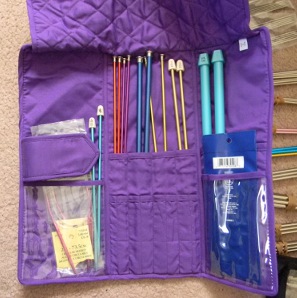
That's probably another $40-$50 there.
Crochet
So, what do you need to crochet anything and everything? This:

That's it. Well, it's not all the crochet hook sizes you can get (I don't own my own Q or M hook, nor all the 'steel' ones), and I managed to lose my G hook when it fell out of a hole in the plastic bag I had a project it (which, ironically, was a knitting project. I was carrying it around to pick up stitches if I needed to), but that's all the crochet hooks I've ever used. I've crocheted everything from super bulky yarn to crochet thread as well, so it's a good range. That whole thing cost me around $40. If I got the rest of the set, it would cost me around $60-$70. Of course, this presumes you get the same hooks I did, which the cheap Boye ones (which are fine since I prefer metal hooks, and all a crochet hook has to do is hook the yarn through a loop. I also prefer the hook shape on the Boye's; there's another cheap brand that does a different style hook, and I don't like it. That's probably what the green, extra K hook I have on the left is. I never use that hook). If you go to a mid-upper-level style of hook, it may cost more more like $100 (though I just looked, and you can even get a Clover soft set for $40, though you may need a couple extra sizes).
Conclusion
So, in terms of tools, crochet is pretty good. Only need a small set of crochet hooks, maybe some shared notions like a stitch marker and/or row counter, and you're set. Knitting requires way more tools and notions, and that costs money. Also, due to the way you use knitting needles, quality becomes a lot more important, also upping the cost. In conclusion, if you're really broke and don't already knit or crochet, learn how to crochet. Or stick to one area of knitting, so you don't need as many tools. Or find a knitting friend that will loan you stuff. They all work. If you're not broke, then just be prepared to spend a lot building up your tool stash if you're learning to knit. Or ignore how much money you're spending on your hobby. Either way works.
But first, I would like to announce that I finished this:

I'll go over my final thoughts on it in a write-and-dash post later. Now, to the comparison.
Knitting
To knit one simple project, you really only need two needles of the correct size. You may also need something like a stitch marker or a counter, but I won't count those because you need them for both crafts. That's it. Simple, right?
Nope. Not in the slightest. One of the more shocking things to me about knitting was how may damn needles you need to do all the projects you want to do. Want to knit a sweater? Depending on the sweater, you may be able to get away with a set of straight needles in the correct diameter (if knit flat or a cardigan), or you may need one or a couple of circular needles in the correct size and length, and a set of DPNs or longer circular needle to do the sleeves. If it has ribbing, you usually need another set of needles a size down. If you do hats, you usually use 16" circulars and DPNs, or a longer circular to Magic Loop the whole hat, presuming the hat's worked in the round. For socks, you'll need tiny DPNs or long circulars that you most likely wouldn't be using for other projects. I could go on and on. The thing is, if you knit anything and everything like me (well, not everything. I haven't gotten to socks yet since I don't usually like to wear them, but I will eventually) in any and all yarn weights (I've knitted everything from super bulky to light fingering), you end up needing a lot of different needles. If you're a person who prefers straight needles (not me), you're going to need a whole set of straights, a whole set of DPNs, and some circulars for those random projects that need to be knitted in large rounds. If you like circulars like me, you maybe could get away with less needles, assuming you prefer magic loop as well and don't buy a whole set of DPNs before you realize that.
That's the other thing, though. If you're new, you're usually directed to the straight, cheapo needles and set to go (unless, of course, you learned from someone who preferred differently and/or knew better). That's what I started on, having learned out of a book bought at a big-box craft store. Then, if you expand your horizons beyond scarfs, you'll mostly likely find your way to DPNs and circulars when needed. If you don't hate circulars and/or don't absolutely love and can't deal without straight needles or just prefer circulars, you would be smart to sit back, realize that in order to do all the things you want to do, you'd need to buy not only a different size needle, but 3-5 different lengths for the circulars, so it'd make sense to invest in a interchangeable set now, before you buy all those needles. You'd be really smart to realize that you prefer magic loop before you buy all the DPNs, but hey, it's the price I pay for learning without another knitter around.
Anyway, here's all my current tools:

I was lucky and realized I preferred circulars and things knitted in the round early, so I went and bought the interchangeable set from KnitPicks, which definitely has saved me money and kept my needle count down. I chose this one because I prefer metal needles and decent prices, and the other two metal sets in existence didn't fit both criteria (Boye's is cheap, both in price and quality, and the other one (I'm blanking on the brand) was more expensive for less sizes). I've had a couple of issues with the cables popping out of the metal screw top, and needles becoming unscrewed despite being tightened, but nothing major or constant (and KnitPicks did replace a cable for free when it broke on me the first time I used it. They're pretty good about that). And I have to say, I love the sharp points. My right index finger will beg to differ, but that's all right.
Oh, and I still need more needles if I ever get around to that sock, since the smallest interchangeable head is a US 4, and I don't own a solid US 0, 1, or 2 in a length above 24".
Also note the notions in the right hand corner. Needle caps, cable needles, stitch holders...all notions unique to knitting. Even with the interchangeable set keeping some of the cost down, I'd have to say that all those tools in that picture are worth around $200 US dollars (still need to actually tally it). Not counting the purple holder at the bottom, which has the straights I bought before I went circular and interchangeable:
That's probably another $40-$50 there.
Crochet
So, what do you need to crochet anything and everything? This:

That's it. Well, it's not all the crochet hook sizes you can get (I don't own my own Q or M hook, nor all the 'steel' ones), and I managed to lose my G hook when it fell out of a hole in the plastic bag I had a project it (which, ironically, was a knitting project. I was carrying it around to pick up stitches if I needed to), but that's all the crochet hooks I've ever used. I've crocheted everything from super bulky yarn to crochet thread as well, so it's a good range. That whole thing cost me around $40. If I got the rest of the set, it would cost me around $60-$70. Of course, this presumes you get the same hooks I did, which the cheap Boye ones (which are fine since I prefer metal hooks, and all a crochet hook has to do is hook the yarn through a loop. I also prefer the hook shape on the Boye's; there's another cheap brand that does a different style hook, and I don't like it. That's probably what the green, extra K hook I have on the left is. I never use that hook). If you go to a mid-upper-level style of hook, it may cost more more like $100 (though I just looked, and you can even get a Clover soft set for $40, though you may need a couple extra sizes).
Conclusion
So, in terms of tools, crochet is pretty good. Only need a small set of crochet hooks, maybe some shared notions like a stitch marker and/or row counter, and you're set. Knitting requires way more tools and notions, and that costs money. Also, due to the way you use knitting needles, quality becomes a lot more important, also upping the cost. In conclusion, if you're really broke and don't already knit or crochet, learn how to crochet. Or stick to one area of knitting, so you don't need as many tools. Or find a knitting friend that will loan you stuff. They all work. If you're not broke, then just be prepared to spend a lot building up your tool stash if you're learning to knit. Or ignore how much money you're spending on your hobby. Either way works.
September 24, 2011
Obligatory First Post, or How I Learned to Compile Yarn
The obligatory first post of every craft blogger (in my opinion at least) is how exactly you ended up so obsessed with this stuff anyway. Knitting? Crocheting? Don't you have better things to do with your time, like playing Angry Birds on your smartphone? Isn't that the obligatory bus activity after sleeping?
Well, other than the fact that I currently don't own a smartphone, the answer is that I like making things. I like making things in ways that only annoy me sometimes. I like getting to the end of the day, a day where everything could be going to hell, and being able to say: 'Well, I spent my whole day trying to get this program to work and it still doesn't work, but I got part of this sweater done, so I'm not completely useless.' I also like being able to do something during my commute which has tangible results, and keeps me from falling asleep (I don't care how interesting a book can be, when you get up at 4 in the morning, you'll still fall asleep. If I fall asleep knitting, then there's no hope that day. Falling asleep on the bus results in more headaches than not for me).
The second part of this is, of course, how did I learn? Well, my mother taught me to crochet when I was in 2nd grade, and since then I've picked it up on and off depending on if I was motivated enough. I got good enough to start making up my own crochet patterns when I was in high school. Crochet kippot, mainly. I then dropped it all in college, more or less, making only a scarf for a roommate during that time.
When I graduated and started working full time, I found myself back home with nothing much to do, and more time to do things. Needing a hat and scarf to wear to work, I picked up my crochet hook again and BS'ed a hat and scarf set. I then set out to prove I could do something bigger, found a afghan pattern I liked, and completed it (that afghan is the Demented Squares Afghan, by the way). From then on, I always had a project going, though I didn't devote much time to them. Part of the reason is that I never found crochet patterns I loved, and I wasn't good enough to make anything amazing on my own. My mom also scared me away from making wearables, as she has trouble with them, though I started getting over that.
Then, one weekend, my mom decided that she would try to learn how to knit. I decided that I would try to learn with her. We went out, bought a learn-to-knit book, needles, and yarn. My mom ended up getting frustrated and dropped it. I, however, learned to knit. (In a completely unplanned step, so did my youngest sister, who never got the hang of crochet and so had spent much time ignoring yarn crafts (she, however, cross-stitches amazingly well. It's a craft I wouldn't touch with a ten-foot pole. I hate sewing and anything like it)).
I then learned that despite spending all that time wondering why the hell someone would do a craft that involved more than one active loop at at time, I loved to knit. It made a fabric I liked the look of better and that worked much better for wearables. There were tons of patterns out there than I liked, and I then found Raverly. Enough said. It was new to me, and I was motivated. I also learned to knit just at the time I was looking into getting more into crocheting, and it took me right off that track and applied my motivation to another one.
So now it's a little over a year later, and I now mostly knit. I still crochet, and I think there are still some things that are better crocheted (another topic for another day). Its all gotten me though hard times at work, gave me gifts to give people, gave me something that I could do on the bus and stay awake, and let me get shirts that actually fit (when I do it right, of course).
And now I should go to bed. To come, I'll cover some of the issues I had learning to knit, talk about some of my thoughts on both crafts and where I stand with them, as well as mention why I named the blog what I did (it's more embarrassing than exciting, so don't get your hopes up).
'Night.
Well, other than the fact that I currently don't own a smartphone, the answer is that I like making things. I like making things in ways that only annoy me sometimes. I like getting to the end of the day, a day where everything could be going to hell, and being able to say: 'Well, I spent my whole day trying to get this program to work and it still doesn't work, but I got part of this sweater done, so I'm not completely useless.' I also like being able to do something during my commute which has tangible results, and keeps me from falling asleep (I don't care how interesting a book can be, when you get up at 4 in the morning, you'll still fall asleep. If I fall asleep knitting, then there's no hope that day. Falling asleep on the bus results in more headaches than not for me).
The second part of this is, of course, how did I learn? Well, my mother taught me to crochet when I was in 2nd grade, and since then I've picked it up on and off depending on if I was motivated enough. I got good enough to start making up my own crochet patterns when I was in high school. Crochet kippot, mainly. I then dropped it all in college, more or less, making only a scarf for a roommate during that time.
When I graduated and started working full time, I found myself back home with nothing much to do, and more time to do things. Needing a hat and scarf to wear to work, I picked up my crochet hook again and BS'ed a hat and scarf set. I then set out to prove I could do something bigger, found a afghan pattern I liked, and completed it (that afghan is the Demented Squares Afghan, by the way). From then on, I always had a project going, though I didn't devote much time to them. Part of the reason is that I never found crochet patterns I loved, and I wasn't good enough to make anything amazing on my own. My mom also scared me away from making wearables, as she has trouble with them, though I started getting over that.
Then, one weekend, my mom decided that she would try to learn how to knit. I decided that I would try to learn with her. We went out, bought a learn-to-knit book, needles, and yarn. My mom ended up getting frustrated and dropped it. I, however, learned to knit. (In a completely unplanned step, so did my youngest sister, who never got the hang of crochet and so had spent much time ignoring yarn crafts (she, however, cross-stitches amazingly well. It's a craft I wouldn't touch with a ten-foot pole. I hate sewing and anything like it)).
I then learned that despite spending all that time wondering why the hell someone would do a craft that involved more than one active loop at at time, I loved to knit. It made a fabric I liked the look of better and that worked much better for wearables. There were tons of patterns out there than I liked, and I then found Raverly. Enough said. It was new to me, and I was motivated. I also learned to knit just at the time I was looking into getting more into crocheting, and it took me right off that track and applied my motivation to another one.
So now it's a little over a year later, and I now mostly knit. I still crochet, and I think there are still some things that are better crocheted (another topic for another day). Its all gotten me though hard times at work, gave me gifts to give people, gave me something that I could do on the bus and stay awake, and let me get shirts that actually fit (when I do it right, of course).
And now I should go to bed. To come, I'll cover some of the issues I had learning to knit, talk about some of my thoughts on both crafts and where I stand with them, as well as mention why I named the blog what I did (it's more embarrassing than exciting, so don't get your hopes up).
'Night.
Subscribe to:
Posts (Atom)