Showing posts with label crochet hook. Show all posts

April 22, 2014

Misadventures in Shawls, Part 1: Looking for Yarn in All the Wrong Places

So, among all the many things I've been doing recently, I've planned out and have started a lace shawl.

A couple of noteworthy things about this:
  • This is only the third shawl I've ever knitted (in the about 4 years I've been knitting), and the first one was all garter stitch so it doesn't count
  • This is only the second large lace project I've ever knitted
  • This is my first project with beads
  • I made the last lace shawl over two years ago, and it took me six months to complete it
  • The shawl is for my sister.  For her wedding.  In August.  Which gives me four months to do it.
It's not that I've been procrastinating.  The first problem was that the planning part took a couple of months.  The reason it took so much time wasn't the time spent looking for the perfect pattern (I found that rather quickly), or even getting my sister to tell me what she wanted (though that took some effort).  It was finding the yarn.

You see, when you agree to attempt to first match the dress (which is a slightly off-white color), its bad.  Luckily the bride-to-be then stated the preference of having the shawl match the bridesmaids dresses, which were described to me as 'similar to this dark royal blue dress I'm wearing' (which, if you've read my blog, you'll know is my favorite color).  For which I was very happy because finding that color yarn shouldn't be hard, right?  I buy it all the time.

A couple of things about that:
  • The color of the bridesmaids dress wasn't quite that dark royal blue I love, it was a medium blue that loves to change colors in different lighting (thank you to the people who suggested I could buy a swatch instead of trying to judge it on the computer screen.  That seriously didn't occur to me)
  • Any blue color around it loves to change colors in different lighting...including on a computer screen
  • The amount of lace weight yarn I would consider 'wedding worthy' (read: has a good silk content and/or is smooth and shiny) contains a lot less variety than you'd think
  • That color is hard to find in nice lace weight yarn 
This resulted in several things happening:
  • Having to send back $70 dollars worth of yarn because I jumped the gun and bought it without seeing the dress at all (including computer), and it wasn't the right color (didn't help that the picture made it look darker as well).  Which somehow went the way of Alaska to get back to the west coast, just making it there by the return deadline.  Good old USPS.
  • Having to send back another skein of yarn because it was a completely different color blue than it looked in the photo
  • Running to one yarn store and finding nothing
  • Running to another yarn store and coming back with a 100% wool, single-ply skein that nevertheless was at least close to the right color
  • Running to a third yarn store and ending up with a nice 100% silk yarn that was a variegated...dark navy blue
  • Running to a fourth yarn store and after not finding anything there yarn-wise, bought needles that I thought I'd need (turns out I had to go up a size for gauge, so no dice there either) Oh, did I mention that I don't live anywhere near a yarn store, so running involves more than one subway/bus?
  • Realizing that I had bought the same brand of yarn the last two times, and if I could find the 100% yarn in the wool yarn's colorway, I'd be golden
  • Finding said colorway in the silk yarn online (yes!)
  • Getting it a week later to find out that...it may be the same colorway, but they were not the same color (but it's close enough to the dress so screw it)
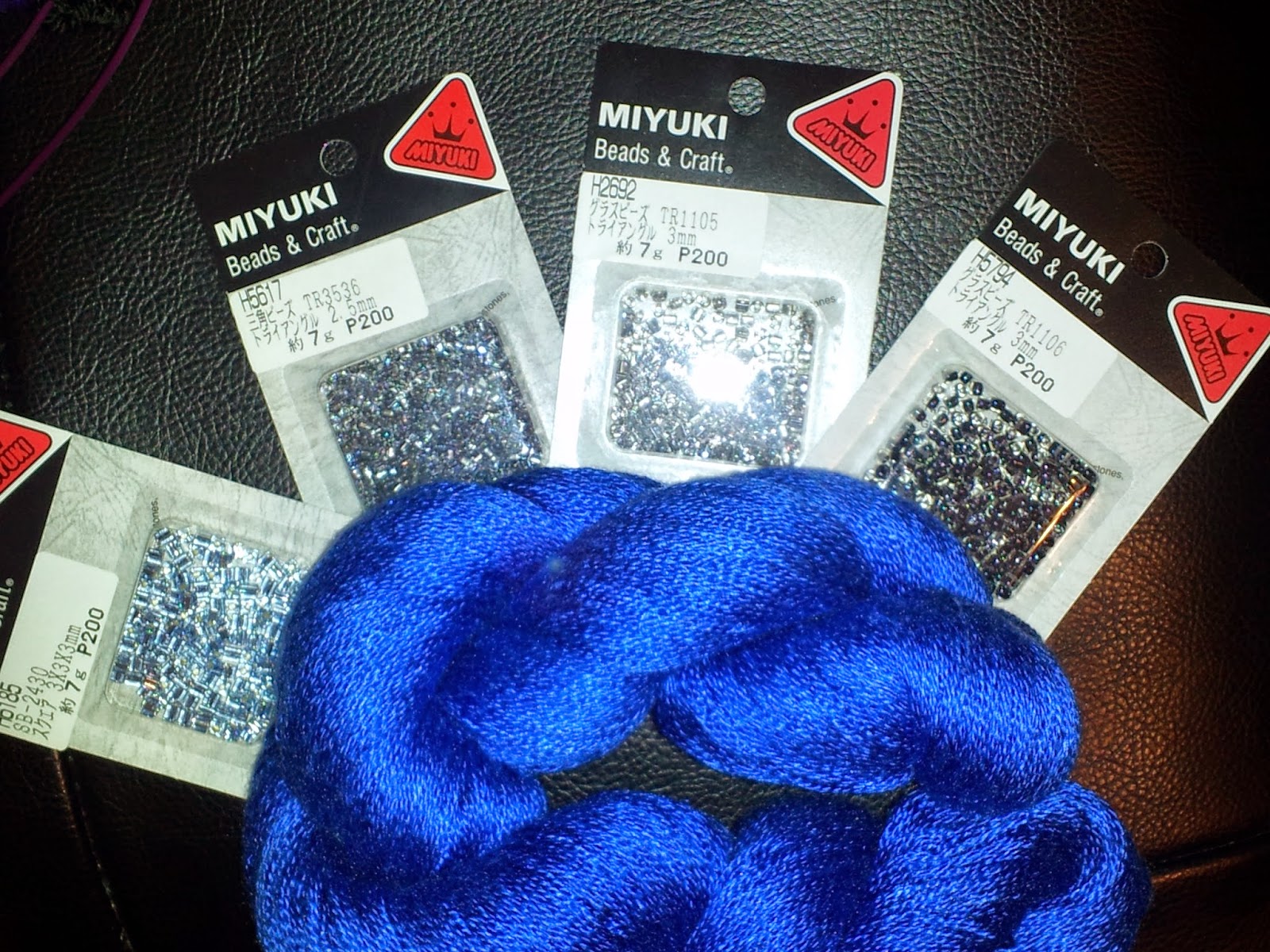
  • Went looking for beads, and when I couldn't find some that matched the yarn, bought a bunch of cordinated ones
  • One, and my favorite of the bunch, of which didn't fit my smallest crochet hook, so I went to a craft store when up at my parents' house to get a smaller one...which was also too big
  •  Going and after checking a sewing supply store for the hook (of which, despite the type of store, they carried a lot of, just not smaller than what I already owned), buying more beads that were similar and bigger than the ones I bought...only to find a smaller crochet hook in a beading store
So yeah, it took me some time.

Here's the two skeins of yarn I got at the local yarn stores:

I really like the dark blue color one, but it doesn't work for this shawl

 And here's the yarn on the left with it's 100% silk, same colorway counterpart:

Yes, that is the same colorway, I swear.  Madelinetosh's Lapis colorway in Prairie (L) and Pure Silk Lace (R)
I don't think I need to tell you that nothing pictured here looks exactly like the color in the photos.  The bottom one is closer to true color, though.

Oh, and some beads:


My sister ended up liking the ones on the far left, though I liked the ones right next to it (those are the evil smaller beads).  I've started using the far left ones, and also these:


Which is kind of a blend between the ones I liked and the ones she liked.  I dunno if I'll still use the other ones.

And this is only the beginning.  The fun didn't end there, but I'll save it for another post.  I better go work on the shawl now (or, more realistically, I'll do a couple of pattern repeats and then go play Skyrim.  Because nothing beats a deadline like procrastination).

March 30, 2013

Guides for Self-Taught Crocheters: Just How Do I Hold the Hook and Yarn Anyhow?

It's about time I do something for the crocheters out there.  I tend to focus on knitting for these posts since I learned how to knit in recent memory, and so I come across stuff in my own travels.  On the other hand, my mother taught me to crochet when I was 8.  It's been awhile.

However, I was in a conversation recently about how one hold the yarn and hook in crochet.  Turns out there's a lot of unofficial variation out there, despite there being only two ways to both hold the hook and to actually crochet.  So I figured that it would be a good idea to not only cover the official ways, but some of the variations out there as well...because, you never know, you may like it better!

Styles vs Variations vs Whatever You Call It
First note that no matter what you may think, the term crochet style is not used the same way the term knitting style is.  A knitting style, as you may know, is how you hold and manipulate the yarn to produce all your stitches.  Crochet style...let's just say that it isn't used much to mean how you hold the yarn and hook to produce your stitches.  That would make too much sense.  Unfortunately, searching fails here.  After searching for the term crochet style on Google, it seems like no one uses it the same way at all.  The first entry is a Pinterest board and the second is a eHow article where the author calls both Tunisian crochet (a different yarn craft with different tools and stitches) and free-form crochet (I could see the usage, but I would call this an approach) 'styles'. It doesn't get any better, on the first two pages at least.

The truth is, there isn't a comprehensible term because the 'styles', in the knitting sense, aren't modular packages like the knitting styles are.  You have the hand you use to hold the hook, and then you have variations that you can pick and choose to use with the hand-style.  I'll call the first the base, since all variations follow from this.

Speaking of such, variations are things like how to hold the hook and wrap the yarn around your fingers. Basically, variations of the standard way of crocheting.  Some of these may be 'official', but some may just be the way you learned or fell into.  I'll cover some of the more popular ones here.

The official ways of holding the crochet hook are sometimes called positions or holds as well.  As you can see, terminology really isn't consistent in crochet.

The Base of Crochet Methods
All variations to crocheting start with what hand you use to hold the hook.  The hand you use to hold the hook is usually determined by your dominate hand, so unless you're ambidextrous or have problems with one of your hands, you'll probably have learned or will learn one base and stay with it.

For example, say you're like me and you're severely right-handed, you'll start with the hook in your right hand, and use your left hand to hold tension in the yarn.  This is usually called Right-Handed Crochet.

On the other hand (ha), you are dominantly left-handed, you'll do the opposite: you hold the hook in your left hand and the yarn in your right.  This is called Left-Hand Crochet.

If you don't favor one hand over the other much, you could pick and choose.  However, I would recommend that you go with the right hand.  Why?  Because almost all crochet patterns presume right-handed crochet. One of the consequences with choosing a base is that it determines which way you create the loops and therefore build the fabric.  With right-hand crochet, you work from right to left, and vice versa.  This has little overall consequence for the final product, or even what variations you use, but unless you're good with spacial thinking, left-handers may find it difficult to picture what's going on in the instructions or provided pictures.  That, and depending on the pattern writer, they may use 'left' instead of 'next stitch' or other similar phrases that assume right-handedness.  Left-handed crocheters have to watch out for that and mirror as needed.

Though, as you may suspect, handedness isn't the end all be all of it.  Since the non-dominate hand does the work of holding the yarn (and usually the work-in-progress), you may find that you prefer the hold the hook in your non-dominate hand instead so that the yarn is in your dominate hand.  Hand-ness is more important in crochet than, say, knitting, but it isn't everything many make it out to be.

Since to give real instructions means introducing some of the variations (after all you still need the way to hold the hook and yarn to start), I don't have any guides here, but here's a good list of myths associated with left-handed crochet.

Variations
So how do you hold the hook and hold tension in the yarn? Well, that's a lot more complicated.  There's a lot of variation, and it has little to do with the base or necessary technique usage and a lot about preference or what your teacher (both meatspace and not) used.  The only effect on the final product these variations have is personal to the crocheter...that is, you may find that one method produces neater stitches for you vs another.  Therefore, I won't make any broad recommendations as to which one to try first or learn.  You need to play around to find your best fit.

Holding the Hook
There are two official methods of holding a crochet hook: the knife method and the pencil method.  These are no way the only two variations in holding the hook, but they are what you'll run into if you learn from most sources, and I'd say the many of the variations are variations of these two methods.

The knife method, also called the overhand or over-the-hook method, is called that because you hold the crochet hook like you would a knife.  See the second set of pictures on this site and this site (also the third set there), and the first set on this site for slightly different variations on this method.  The key is that the shaft is under the palm of the hand with your thumb and some forefinger or set of forefingers on the grip.  While some sources will say to use your index finger and thumb, you can also use your middle finger and thumb, or all of them.  The other fingers aren't technically involved in the classic style of this method, but you may find yourself wrapping your pinky, ring finger, or both around the shaft of the hook (for stability and/or to help guide or move the hook).  Another connected variation is holding it 'fist like', like many of the commenters in the second link.  The hook can be facing you (see the first and third link), towards the floor (see second link), or the opposite of both of those (I guess, though I haven't see it).  However, hook position will be more of a consequence on how you hold the hook instead of a direct choice.  You may also turn the hook as you're crocheting.

The pencil method, also called the underhand or under-the-hook method, is also named after the common utensil in which the grip is similar.  See the first set of pictures in the first two links above, and the second in the third link for examples.  The key here is that the shaft is resting on or floating around the area between the thumb and forefinger, and only those two fingers are holding the crochet hook.  This method is a little less popular and so there seems to be less examples of variation to it, but it's possible.  For example, you can use your middle finger to grip instead of your pointer, and use the pointer to guide the hook (I tried it and found it easier that way than standard pencil grip, actually, but then again I'm weird and use my middle finger and thumb to grip all hooks and needles).

Holding the Yarn
On the other hand, there's no 'official' methods to hold the yarn, and the variations are endless.  However, there are right ways and wrong ways to do it.  This is because the way you hold the yarn has a direct effect on how tightly or loosely your stitches will come out (for the knitters out there, this doesn't hold as true for knitting due to how the stitches are produced, but that's a different topic).  Use the wrong hold, or the wrong one for you, and your stitches may be uneven, too loose, or too tight.

I say the wrong one for you because a right method that works for a million people may not work with your hand, especially since this is the non-dominate one we're most likely talking about.  Hands vary in size, shape, or strength, and that will have an effect on which method you prefer. For example, you might have cause two of your fingers to be stiff and prone to locking up because you rammed that hand into a bookcase years ago (ok, maybe that's just me). Things like that all can have an effect. The style you'll like may also change over time and incidents.  That's fine.  As long as you're getting good results, it doesn't matter.

One common way to hold the yarn is to wrap the yarn first around your pinky, and then over one of the other fingers (index, usually, but the middle can also be used) as a guide.  The fourth and fifth pictures down on this site shows this, as well as the first yarn hold method on this page (scroll past the hook holds).  Another variation is the second picture in this link.  The pinky wrap provides the tension, and the other finger is a guide to hold your yarn so that you can grab it with the hook. This method may give you a tighter tension than others, but it can also impede yarn flow as the yarn has to pull through the twist around the pinky finger.

Another is to pull the yarn between your pinky and ring finger, and then pull the yarn from under your fingers up and over your index (or middle) finger.  Grasping the yarn between the last two fingers provides the tension, and again, index or middle is your guide.  You can see this variation in the third picture of the first link in the last paragraph.  This way provides a looser tension, depending on how hard you grip the yarn with your last two fingers.  It may be too loose or you may find that you grip too hard to be conformable with this method.

A third is to hold the yarn with your last two or three fingers (bent towards the palm to hold it), and again, put it up over your index finger.  The third example in the third link above, and the second yarn hold method in the second link show this way.  This way is even looser in tension, if you need that.

There, are, of course, many other methods out there...way too many to list.  The last example on this link (same as the third above) is another, more unique way (the comments are sources for other variations and methods as well).  This link is a variation on the second one I listed that involves having the source of the yarn under the palm instead of over (makes more sense when you look at the picture).  This one shows the crochet just holding the yarn between the index and middle finger. 

If you really have no clue about which one to try, start with one of the three discussed above and modify from there (and if it's unconformable, then try another).  Don't get too frustrated at first, though.  Learning how to control tension in crochet takes some practice no matter what way you hold the yarn.

Conclusion
All in all, crochet methodology is fluid and you may have to experiment to find the way you like.  Have fun with it; after all, it's most likely your hobby.  Or will be, I hope.

January 23, 2013

Vogue Knitting Live Debrief (2013 Edition)

I should've done this Monday, but I was too busy catching up on my sweater and having a battle of wills with a mouse that made its way into my apartment (which, unfortunately, is still going on.  Good news is that I didn't see any evidence from it this morning.  Bad news is that I still haven't caught it, and it escaped one trap and hasn't touched the others I set after that). 

Anyway....onto the Vogue Knitting Live debrief.


In General
I went in expecting more of last year.  It was not.  The whole...feel, I guess is a good word...was different than last year.  Last year was smaller, more fashion forward and had a summery feel to it.  This year was a lot more crowded (on Saturday at least), and the vendors and feel was way more diverse.  In some ways it was like a little Rhinebeck (with many of the same vendors), except with a slight more emphasis on fashion (instead of the more rustic feel of the NYS Sheep and Wool festival, which is to be expected).

I went both days, because like last time I signed up for a lecture on Saturday (and then met my knitting group to trawl around the marketplace), and then I went back to see the shows and the free panels on Sunday (and to trawl around the marketplace alone).  The one constant thing was that the lecture was fun, the panels were interesting (and I got a lot of knitting done), and the fashion shows were mostly horrifying.

The Lecture
I ended up signing up for Manipulating Stitch Patterns conducted by Ysolda Teague.  Unlike the last two times, I've heard of her before (actually, it was her page I found instructions to do those looped button holes for one of my last patterns, which saved my can't-be-bothered-to-plan-for-a-buttonband ass), but that's not why I picked this lecture.  I picked it because for the past four months or so I've been wondering if I shouldn't invest in a stitch dictionary, and if I do, what I will use it for.  You see, I'm pretty picky about my knitting.  There are few patterns I've seen that aren't cables or stockinette that I've liked.  But I keep telling myself I won't do cables in my next project (ha) and I should branch out a little more...or, if I don't find what I like, create it.  It's all easier said than done of course.  So I figured that this lecture should be interesting and help a bit.

While it started late (but it ended on time and provided some laughs, so I don't care), I was happy with it.  While a lot of the tips given seemed somewhat common sense (like calculating a new stitch count when adding or subtracting an element), there were still good tips for me to hear.  One of my major takeaways was an throwaway point, which is that the chart should represent what the pattern will look like.  Her example was a cable chart in that style I'm not too fond of, the one where the cross is a bunch of diagonal lines visually 'representing' the cable.

Now,  I don't like this style because it gets messy with more complicated cables.  I had to read one that had traveling cables, and I found it hard to differentiate between the K2, K2 cables and the K2, P1 cables (putting a tiny dot near the bottom left does not make a clear symbol).  Also, as many of them aren't standardized (despite what the link above tries; you'll notice that they have no traveling cables in there), they vary by just enough that it's confusing.  I can't imagine what a K4 with a P stitch in the middle cable would look like in that notation.  But Ysolda's comment of 'the chart should look like the pattern' made me realize why people like that style: taken together, the chart really does show the cable flow.  It looks like the cable, because many of the symbols look like the shape the knitting makes (of course, there are other similar styles.  Standardization doesn't exist here).

She also mentioned, in relation to that point, that the chart shouldn't be a code.  I think that's my biggest pitfall here.  I'm a programmer.  I see charts as codes, I'm conformable with charts as codes, and judge their merits as such.  I like clear, flexible codes over pictorial representation that just complicates matters.  This is why my currently preferred notation is one I learned in Aran Knitting, which looks similar to the chart in this link.

It doesn't really show the pattern when you see it as one object.  But it does give flexibility to represent all types of cables (as any cable uses a variation of the same symbols), and is much easier to write out when I'm pattern drafting (and on the computer without buying special software like she was using in the lecture).  But you do have to learn it and understand it to see the brilliance of it, which doesn't come easy to many knitters.

I also find it funny that crochet is more standerized than knitting in this respect.  But that's another topic for another day.

The other major takeaway I got was that you can fake cables with increases and decreases, and you can use ribbing to do reversible cables.  I had no clue.  That's great to know.

Fashion Shows and the Panels
I only ended up catching two full fashion shows (and bits and pieces of others), but what I saw was pretty much similar to last year.  Weird outfits, modular knitting, garments that don't flatter anything but the coat-hanger models walking down the runway (and then there was this thing.  No excuse for that monstrosity of a cardigan).  Oye.  No novelty yarns this year, though.  And there were a couple more outfits I wasn't revolted by.  Improvement, improvement.

There was two free panels, and I went to both.  One was on being a designer, which while being funny, made me really want to stay an amateur designer.  The other was on the change in knitting culture and where it was going, which was pretty predictable, but wasn't too boring.  Though one panelist had to repeat the whole 'crochet uses more yarn' myth. Ug.

Purchases
I was good, and only got one skein of yarn:


I bought it because not only was a  'oo, pretty blue!' one of a kind Madelintosh skein, it's from my old LYS (who were there, much to my surprise.  The other surprise was that they remembered me after a year of not going (while I had only been their customer for a little over a year)).

I also got another bottle of Soak to replace the one I left in my old apartment (that I bought last VKLive).  While Woolite might be cheaper, you don't have to rinse with Soak.  And it smells a lot better.

Also, the second day I texted my mom this picture:


It was a joke about big crochet hooks.  The next text I get, however, was 'do they have x size?  I'll pay for it.'  Cue back and forth texts where I realized they were Tunisian crochet hooks and attracted the attention of one of the shop people, who taught me to Tunisian crochet (which isn't that hard, but I also knit and crochet, and it's obviously a weird blend of those things).  I then, while waiting for my mother's answer as to if she really wanted the Tunisian version, got hustled into buying the crochet hook. For $40.

I later found a vendor selling normal crochet hooks in the size my mother wanted for normal prices.  I ended up buying those as well.  We'll see if my mom buys the Tunisian thing off of me.  I may get stuck with it.

Conclusion
Overall, I had a good time.  It was different than I was expecting, both good and bad, but I enjoyed it.  Hopefully they'll have better trends next year (ha ha ha).