Showing posts with label st ciaran. Show all posts

November 19, 2012

Crazy Cable Blanket Debrief (With a Bonus Border Pattern)

So, I finished Crazy Cable Blanket:

Yet I cannot make my bed well, or pick up the shoes I haven't worn in months.
It's all done.  Border, blocked, everything.  I can't believe I managed to finish it.  The label I sewed on it says it all:

I ordered them from KnitPicks, but other retailers may have these labels in stock as well
Anyway, since this took about a year and a month of my life (though if I had worked on it consistently, it would have been more around eight months), I figured I go into detailed 'debrief' of the pattern for anyone who's crazy enough to make one.

The Pattern
The pattern I used for the blanket itself was Alice Starmore's St. Ciaran (missing accents; sorry) from the reprinted version of the book Aran Knitting (it may be in the original as well.  I don't know and I can't vouch for that version).  Like all of Alice Starmore's cable work, it is interesting, creative, intricate, and absolutely crazy.  What made this more fascinating is the idea of having cables form Celtic patterns, which involves learning how to make the cable appear like it's making a bend when in fact that's where you started or ended the cable.  As I love cables, and I like Celtic designs, I loved this.  Hell, I bought Aran Knitting because I saw this pattern knitted up in a KnitPicks catalog.

However, the Celtic cabling is also what made the pattern challenging.  Now, honestly, the pattern and the charts that go with it are flawless.  I had no problem learning how to read the chart, setting it up, and following it.  I did have some issues the whole 'start and finish the cable in the middle of it' step in the beginning, though.  The first couple of times I screwed up and had to re-start the blanket.  But after that, all my mistakes were more due to my momentary lapses in paying attention more than anything (can you blame me? Knitting solid cables 200+ stitches across gets a bit tedious, no matter how much you like the pattern).

The other interesting thing about this pattern is that it's actually supposed to be a shawl.  However, it's a really big shawl...what most of us would call a small blanket.

For anyone who wants to attempt the pattern, the advice I'd give to you is:
  1. Use a 60" circular needle.  Use a good quality one as well; you will put stress on the joins between the cord and needle with this pattern and you don't want them popping mid blanket.  However, you will not get far with straight needles unless you are so against circulars you insist on using them.  Your sanity and wrists will thank me later.
  2.  I know it's a blanket, but for the love of the knitting goddess, SWATCH FIRST.  If you're too lazy to swatch one of the charts (which is recommended to learn how to do the cable from nothing trick before you start the blanket and then have to re-start it), at least swatch in stockinette.  Alice Starmore's patterns are notorious for tight gauge (I think I saw someone call it 'bullet-proof'; it's not too much of an exaggeration).  You may have an issue with it and have to go up a needle size or two, depending on the yarn used.
  3. While I used an acrylic/nylon blend successfully, I would still recommend going will some sort of wool, wool blend, or some other flexible, springy yarn for this blanket.  You will enjoy knitting it more with a yarn that doesn't mind going through some gymnastics, because that's all this pattern is.  You may find a different fiber that will work, but tread carefully.  If you need machine washable like I did, you may have to compromise on ease-of-knitting a bit, however you must triple-check that your chosen yarn won't send you to the wrist doctor for pain either (Ravelry reviews of other knitters having done cables with said yarn are a godsend for this).  This is also why you need to swatch, hopefully before you commit yourself to buying all the skeins.
  4. On the other hand, the yardage you will get by calculating it out of the pattern is a bit more than you need, unless you're knitting more loosely or putting the fringe on.  I used a little under 2100 yards on the blanket itself as written (minus the fringe), but bought 2730 yards based on the pattern.  With my border, I used about 2520 yards.
  5. Put stitch markers where each chart ends/begins.  They don't really get in the way and they help you see where all the charts are.
  6. Have separate row counters for each chart, along with one representing the whole blanket. You can use an app for this if you don't want five string-on counters on your needle cord.  The benefit of the app is that most of them will switch all the counters with one button push.  The downside is that you need your phone/tablet around and not dead whenever you knit.
  7. It may be easier if you photocopy the charts so you're not flipping back and forth in the book. I insist on it if you're using a library copy or someone else's copy of Aran Knitting. I didn't do this, and  I broke the spine of my book and the pattern pages de-attached. I had to duct tape them back in. Twice.
  8. Don't try to memorize the charts.  You may get the A chart down pat all right, as it's just a six-stitch braid (and it's the most common chart in the blanket), but you will make more mistakes than anything if you try to memorize the other three charts.  They are too long and complicated.  Save yourself some hair-ripping and just stick with reading the charts.

The Border
The border isn't part of the pattern.  I made it up on the fly.  The blanket just looked unfinished to me without one, and I had extra yarn anyway.  However, the thought of picking up stitches along it and knitting a border...no.  Just no.  So I crocheted it instead.  I love being bi-craftal.

For anyone who wants to go the extra mile of crazy, the border pattern is below:

Start in a stitch or two in front of a corner of the blanket.  It doesn't really matter which corner, but I started on the end of the blanket.

Use a US G/6 (4.25mm) or whatever is slightly smaller than the knitting needle size you're using (Go with the G if you're knitting with an US 7 (4.5mm)). Always end the round by slip stitching (sl st) into the top chain to end the round.  sc = single crochet, dc = double crochet, FPdc = front post double crochet, i = # of side you're on, loc = stitch you're at (the location).  This is a quick and dirty pattern, be warned.  The chart will be added later, as it will take more time to make (though it will be much clearer than my written instructions for many people, I think.  I said it was a bonus).
Round 1:  for(i=0; i < 4; i++){sl st to loc == corner st.  3 sl st.} sl st to loc = 0
Round 2:  Ch 3. for(i=0; i < 4; i++){dc to loc == corner st. 3 dc.} dc to loc = 0
Round 3: Ch 2.  for(i=0; i < 4; i++){sc to loc == corner st. 3 sc } sc to loc = 0
Round 4: Ch 2. for(i=0; i < 4; i++){while(loc != corner st ){sc. FPdc into below dc.} if(loc == corner st){sc, FPdc into corner dc stitch, sc.}}. do{sc. FPdc into below dc.}while(loc != 0)
Round 5-8:  Round 3
Round 9: Round 2
Round 10:  Round 4
Round11: Round 3
I can't tell you how many stitches I did on each side, because I was lazy and didn't count (and therefore had too many stitches and had to decrease. Then I had to learn how to property decrease in crochet, because I realized I've never had to decrease in a way that didn't involve just skipping the stitch.  The result was that I learned that decreasing in crochet is just a two stitch cluster, but I still had a few too many stitches on the ends).  I will tell you that you need to slip stitch into every knit stitch on the sides of the blanket, but you'll need to only do a percentage of them on the ends.

The Yarn
The yarn...what can I say? I used Berroco Comfort in color 9763 (it's a navy blue color, despite some of the photos I took). I knew everything about it from the reviews I read, and I pretty much had the same experience, minus one.  The good is that it's cushy and provides enough stitch definition for cables.  It's also machine washable and dryable, which is good for a blanket for a 13-year-old.  I haven't run it in the washer machine yet, but it's been in the dryer and it came out fine.  The steam blocking job I did created a bit of fuzzy, but that's because I wasn't being careful (it does say not to iron the yarn and while I was using a pillowcase between the iron and the blanket (wet pillowcase = steam without the steam setting), I was pressing too hard and had the iron up too hot).

The bad is that it does have a tendency to split into tiny threads, especially on the sharp tips of the metal needles I prefer.  I'm pretty used to this by now, as I can split yarns that almost never split when using said needles, but it's a bit of an issue with this yarn in particular. Also, you don't have the desired flexibility with the yarn that you may want with such a cabling job.  Sliding the stitches and twisting them are a bit tougher than one may like or expect with a good flexible yarn like wool.

The one thing I do disagree with from a review I read was that I found it easier to crochet with than to knit with.  Since the crochet hook was blunt, and my knitting needles were sharp, I had less of an issue with splitting when crocheting with it. It still split, don't get me wrong, but not as badly.  But maybe my experience is tainted with the fact that I was crocheting simpler stitches than I was knitting, so it just tolerated the less demanding stitchery better.

Conclusion
This was one of the most trying projects I've worked on, and there were many times I dropped it like a hot potato and let it cool for a couple of months. It got tedious some days, and I can't believe I spent so much time on it.

The next one I do is for me. In a nice wool.  I keep staring at it; I love the cables and I want one now.  Or maybe I'll adopt the cables in St. Brigid into a shawl like I wanted to do before I do another Crazy Cable Blanket.  Or actually get around to making Eala Bhan, which is the other pattern I bought this book for.

Don't worry, it won't happen any time soon.  I have enough yarn for other projects already that it'll be awhile before I get around to buying yarn for another one of these....

November 1, 2011

I'm Still Here

It's just that I've been a little busy, and buses have been running a little late recently, so I haven't managed to sit down and write a good post.  I'll do it this weekend, I promise.

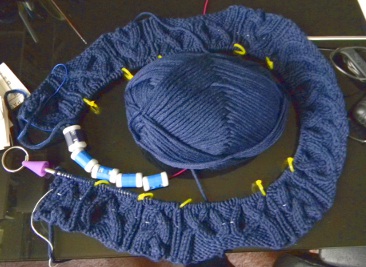
Well, not doing it last weekend was all my fault.  I was too busy trying to make progress on the Crazy Cable Blanket:


In which my brother informed me, after I made the point that I had only done 45 rows out of 420, that he thought I'd have it done by the end of November, and was therefore shocked I hadn't made much progress.  I pointed out that I had told him that I wouldn't be done by Hanukkah, so what made him think I would be done by November?  Really?  It's not that I'm a fast, well, anything, and they know that.  It takes me a couple of months at best to crochet an afghan, and that's a not-so-complicated, bulky weight, one.  Knitting crazy cabling in worsted weight?  Yeah, I'll be lucky if I have it done by the end of the cold season.

Anyway, if you ignore the rather icky cable job in one place, and the day I picked it up, proceeded to make 3 mistakes in two rows, hacked fixes for them, and put it down thinking it would only get worse from here, I'm making progress.  Slow progress, but progress.  Though I'm not using lifelines anymore, so if I really screw up I'm back to row 20. Yeah, maybe next year he'll get it as a Hanukkah present.  Maybe.

October 10, 2011

Problems with Vinegar Baths and a Resultion to Ribbing Woes

Ok, so I decided to still do the 1x1 ribbing on the bust of my Milk Maiden sweater:


To keep it tighter, I kept all the stitches I either knitted or purled on the tip of the right hand needle until I did the next one.  It seems to be working as good as the examples of other peoples' work I looked at.

On the other hand, I was helping my mom block a shawl she crocheted today (yay corporate holidays).  I ended up doing most of the work because the yarn she used, Madelinetosh's Tosh Light, bleeds oh so very much, and I dealt with the same problem with my Tosh Light shawl.  Now, for my shawl, I stopped the bleeding with two vinegar washes.  Hers...well, it was still bleeding after soaking it in three vinegar baths.  I just gave up and told her to tell the giftee that if they wash it, not to wash it with anything else.  It at least wasn't as bad as it had been.

Now, from my research, I know that vinegar is supposed to be the best way to stop bleeding yarn.  So I don't get what I'm doing wrong.  Am I diluting the vinegar too much?  Does it not work for some yarn dyes? Was I not using enough vinegar (the shawl was a whole lot bigger than mine, but I can't say I measured the vinegar out any of the times I used it)? I'm confused. 

At least I wasn't as confused as my stepfather, who was questioning my use of the vinegar, saying that he used vinegar as a caustic agent to clean out the coffee pot (that had recently decided to clog up and overflow coffee every time someone made it.  I claim no fault.  It worked fine for me last Friday).  I stupidly replied: 'Well, don't you know that that's how Easter eggs are set?,' completely forgetting that my stepfather has never dyed Easter eggs (explaining this would unfortunately require a whole paragraph, so I'm not).  My mom and I had to explain that vinegar is used in Easter egg dye to set the dye on the egg (for any other folks out there who've never dyed Easter eggs for one reason or another).

Tomorrow, it's back to my actual paying job, and not knitting the crazy cable blanket.  That I just found a mis-crossed cable on.  Ug.

October 2, 2011

Internal Rules and Current Projects

I know I wrote last time that my next post would be on something different.  That was last week.  I'll get there at some point, I promise.

For now, however, I'll cover something that's currently on my mind, and in the meantime cover what I'm working on now (as well as a couple of past projects).  Therefore, I present the first set of my Internal Rules for Knitting.  These are some rules that help keep my knitting under control, which means they're broken half the time.  Anyway:

1) I will only buy yarn if I have a project in mind for it  After all, this is what I ended up with the first time I didn't do this:

Yeah, that's a current picture of some ugly Lion Brand Swede sitting in my stash

I told myself after that little incident that I would never buy yarn on a whim again.  I would wait until I had picked it for a specific project.  Especially if it was on sale or cost a pretty penny. This would keep my yarn spending under control, and make sure I use what I buy.

However, it also seems that it's quite valid to make an exception when I feel bad about returning yarn to my LYS because I was allergic to it and bought the substitute yarn online.  That's how I ended up with two skeins of this:


The yarn is Madelinetosh's Tosh Light in their Baltic colorway, which I am rather attracted to.  That shawl is the first skein, and came out of the fact that I bought this yarn on a whim.  This, of course, leaves the second skein just sitting there, because while I enjoyed the challenge of learning how to knit lace, I'm not touching it again any time soon. It's this pattern, no modifications. My notes on it here.

It also seems that I'll make an exception I find out some distance relative is having a kid, and I have lofty goals and loads of motivation that I'll make dozens of baby things.  That's how I ended up with all of this:


At least I got a project done for said baby, though it only took one skein of that grey yarn in the back (Bernat's Softee Baby in Gray Marl by the way, though if you can't stand acrylic, don't get it.  It works up like acrylic, though it softens up in the wash)  That sweater is a modified version of this pattern. For notes, go here.

2) I will not spend more on yarn for a project than it would cost me to buy the finished product retail.  This will make my knitting practical, and save me money.  Well, sometimes.  It turns out that an alpaca sweater can retail for $130-140 dollars, which of course is only a little higher than I spent on making this:

However, spending a year and making several projects while twisting your knit stitches is priceless. But that's another post.  This is a modified version of this pattern.  My notes here.

It was also a gift to my mom, so I really didn't care about that one so much.  Given that she's spent more than that making a crochet bedspread that I grew to not like pretty quickly, among other things.  However, it also seems that the rule goes out the window if I like the colorway, which is how I ended up with this:

Project notes are here

This is my current bus project.  The pattern is the Milk Maiden Pullover from Brave New Knits, and it's one of the only reasons I bought the book.  The yarn is Madelintosh's Tosh Sport in their (new?) colorway Fathom. I officially love this colorway. Look at it, my favorite color combination, just slightly variegated enough to be interesting. It's perfect for this pattern too. I had to get it. I don't care if I can get a sweater for $40 bucks and this cost me almost $70, it's worth it. And I'll break rule number 1 if a Madelinetosh Sock onesie pops up in this colorway. Or this colorway gets discontinued. Love, love, love.

And yes, I've modified it, since I modify almost everything.  Why I tend to modify everything is another post, though. Back to the rules.

3) I will use up most of my stash before buying more yarn. Yeah, never managed to follow this one:

Most of my stash. It's a combination of whim yarn and extra skeins from other projects. It lives under my bed and out of my mind for the most part.

The only thing that makes me feel better about that is that it seems that most people I read about online have much larger stashes.  Hey, mine (barely) fits in a Tupperware container. Then again, they seem to have much nicer yarn in their stashes too. Yay?

And now for a rule I'm actually not currently breaking:

4) I should only have one bus project and one at-home project at a time.

First, I'll define what I mean by 'bus project' and 'at-home project'. Bus projects are, obviously, projects that I can do mostly on on the bus. This means that they get worked up faster, but they tend to be simpler. Though 'simpler' is a bit relative, as I have no problem including some sweaters in this pile, as you can see from my bus project above. If it fits in my briefcase and doesn't require either being chained to the pattern or a chart or a lot of color-work, I can usually do it on the bus. Lots of stockinette or very repetitive patterns are a plus here, though I have done drop stitch lace, finishing off projects, and cables on the bus successfully. On the other hand, at home projects are usually things I want to make, but are way too big and/or complicated to work on on the bus. This officially started when I made that lace shawl above, as I realized that in order to make a lace shawl, I was going to need to be chained to the pattern and be able to finish a row in a sitting. I can't do this on the bus without really annoying my fellow passengers. I decided to spare them.

I'm now working on this:

My project notes are here

This is the pattern St. Ciaran from the new and expanded version of Aran Knitting. I'm not really mortifying it (gasp!), though I'm using Berroco's Comfort Worsted to make it instead of a wool-based yarn. This is because I'm making it for my brother, who's still a kid and still trashes things. Therefore, it had to be 1)washable and 2)not too expensive to make. I picked the pattern out, though he approved it. I like torturing myself, though I'm not finding it too hard at this point, just tedious. I should be working on it right now.

I'll go do that.